Advertisements
Advertisements
Question
Fig shown a block and tackles system of pulleys used to lift a load.
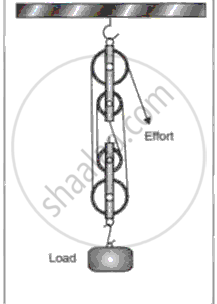
(i) How many strands of tackle are supporting the load?
(ii) Draw arrows to represent tension in each stand.
(iii) What is the mechanical advantage of the system?
(iv) When load is pulled up by a distance 1 m how far does the effort end move?
Advertisements
Solution
(I) 4 stands of tackle are supporting the load.
(ii) correct winding of rope around pulleys, load and effort is as shown:
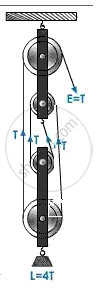
(iii) M .A = L/E
here,L = 4T, E = T
M.A = `(4"T")/"T"` = 4
(iv) since there are four strings in the block and tackle system, therefore, the velocity ratio of the system is V.R = n = 4
Now, V.R `"d"_"E"/"d"_"L"`
or, `"d"_"E" = 4 xx "d"_"L" = 4 xx 1 = 4"m"`
RELATED QUESTIONS
Fill in the blank:
A pulley is used to change ........................
The mechanical advantage of an actual pulley is less than one. Give a reason. What is the justification for using the pulley then?
Explain how a gear system can be used to obtain gain in torque? Given one example.
Define the following term in reference to a gear system for Driven gear ?
In a gear system, the gear ration of the driving wheel A and driven wheel B is 10:1. To rotate the driven wheel B in the direction of driving wheel A, the driving wheel A is engaged with other wheel C. what should be the gear ratio of the wheels A and C?
What is a block and tackle system of pulleys?
Draw a diagram of a single fixed pulley and obtain expressions for its:
(i) Mechanical advantage,
(ii) Velocity ratio, and
(iii) Efficiency, in the ideal case.
A man raises a load of 360 kgf using a block and tackle system of 3 pulleys. If the efficiency of the pulley system is 60%, what effort is applied by the man?
| Meera chose to use a block and tackle system of '9' pulleys instead of a single movable pulley to lift a heavy load. |
Why should she connect more number of pulleys in the upper fixed block?
Name the type of single pulley that has an ideal mechanical advantage equal to 2. Draw a labelled diagram of the pulley mentioned by you.
