Advertisements
Advertisements
प्रश्न
Fig shown a block and tackles system of pulleys used to lift a load.
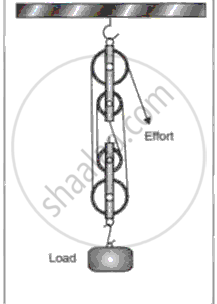
(i) How many strands of tackle are supporting the load?
(ii) Draw arrows to represent tension in each stand.
(iii) What is the mechanical advantage of the system?
(iv) When load is pulled up by a distance 1 m how far does the effort end move?
Advertisements
उत्तर
(I) 4 stands of tackle are supporting the load.
(ii) correct winding of rope around pulleys, load and effort is as shown:
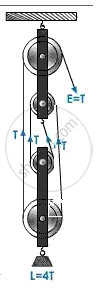
(iii) M .A = L/E
here,L = 4T, E = T
M.A = `(4"T")/"T"` = 4
(iv) since there are four strings in the block and tackle system, therefore, the velocity ratio of the system is V.R = n = 4
Now, V.R `"d"_"E"/"d"_"L"`
or, `"d"_"E" = 4 xx "d"_"L" = 4 xx 1 = 4"m"`
संबंधित प्रश्न
From the diagram given below. answer the question that follows:
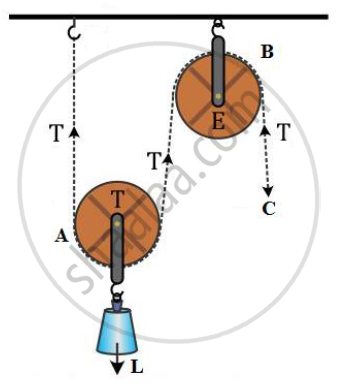
- What kind of pulleys are A and B?
- State the purpose of pulley B.
- What effort has to be applied at C just raise the load L = 20 kgf?
(Neglect the weight of pulley A and friction)
A block and tackle system has V.R. = 5.
Draw a neat labeled diagram of a system indicating the direction of its load and effort.
What is the mechanical advantage of an ideal pulley?
What is the justification for using the pulley then ?
Name a machine to change the direction of force ?
The mechanical advantage of an ideal single movable pulley is ______.
State two reasons, why the efficiency of a pulley system is not 100 percent?
A type of single pulley is very often used as a machine even though it does not give any gain in mechanical advantage. Name the type of pulley used.
A block and tackle system of pulleys has a velocity ratio of 4.
- Draw a labelled diagram of the system indicating clearly the points of application and directions of load and effort.
- What is the value of the mechanical advantage of the given pulley system if it is an ideal pulley system?
A man raises a load of 360 kgf using a block and tackle system of 3 pulleys. If the efficiency of the pulley system is 60%, what effort is applied by the man?
