Advertisements
Advertisements
Question
For the reaction:
\[\ce{2A + B → A2B}\]
the rate = k[A][B]2 with k = 2.0 × 10⁻⁶ mol−2 L2 s−1. Calculate the initial rate of the reaction when [A] = 0.1 mol L−1, [B] = 0.2 mol L−1. Calculate the rate of reaction after [A] is reduced to 0.06 mol L−1.
Advertisements
Solution
Given: [A] = 0.1 mol L−1,
[B] = 0.2 mol L−1,
k = 2.0 × 10⁻⁶
The initial rate of the reaction is
Rate = k [A][B]2
= 2.0 × 10−6 × 0.1 × (0.2)2
= 8 × 10⁻⁹ mol L−1 s−1
When [A] reduces to 0.06 mol L−1 i.e. 0.04 mol L−1 of A has reacted, then the reactant B
= `1/2 xx 0.04`
= 0.02 mol L−1
Hence, the new [B] = 0.2 − 0.02 = 0.18 mol L−1
Thus, the new concentrations of A and B are
[A] = 0.06 mol L−1,
[B] = 0.18 mol L−1,
Now rate = 2.0 × 10−6 × (0.06) × (0.18)2
= 3.89 × 10⁻⁹ mol L−1 s−1
APPEARS IN
RELATED QUESTIONS
Write molecularity of the following reaction:
2NO(g)+O2(g)→2NO2(g)
For a reaction A + B ⟶ P, the rate is given by
Rate = k [A] [B]2
How is the rate of reaction affected if the concentration of B is doubled?
For a reaction : 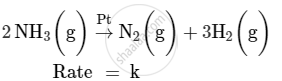
(i) Write the order and molecularity of this reaction.
(ii) Write the unit of k.
For a reaction, \[\ce{A + B -> Product}\]; the rate law is given by, `r = k[A]^(1/2)[B]^2`. What is the order of the reaction?
From the rate expression for the following reaction, determine the order of reaction and the dimension of the rate constant.
\[\ce{CH3CHO_{(g)} -> CH4_{(g)} + CO_{(g)}}\] Rate = k [CH3CHO]3/2
A reaction is first order in A and second order in B. Write the differential rate equation.
A reaction is first order in A and second order in B. How is the rate affected on increasing the concentration of B three times?
How does calcination differ from roasting?
Define the following term:
Pseudo first-order reaction
Molecularity of a reaction _____________.
Rate law for the reaction \[\ce{A + 2B -> C}\] is found to be Rate = k [A][B]. Concentration of reactant ‘B’ is doubled, keeping the concentration of ‘A’ constant, the value of rate constant will be ______.
Compounds ‘A’ and ‘B’ react according to the following chemical equation.
\[\ce{A(g) + 2B(g) -> 2C(g)}\]
Concentration of either ‘A’ or ‘B’ were changed keeping the concentrations of one of the reactants constant and rates were measured as a function of initial concentration. Following results were obtained. Choose the correct option for the rate equations for this reaction.
| Experiment | Initial concentration of [A]/mol L–¹ |
Initial concentration of [B]/mol L–¹ |
Initial rate of formation of [C]/mol L–¹ s–¹ |
| 1. | 0.30 | 0.30 | 0.10 |
| 2. | 0.30 | 0.60 | 0.40 |
| 3. | 0.60 | 0.30 | 0.20 |
For which type of reactions, order and molecularity have the same value?
Why molecularity is applicable only for elementary reactions and order is applicable for elementary as well as complex reactions?
Match the graph given in Column I with the order of reaction given in Column II. More than one item in Column I may link to the same item of Column II.
| Column I | Column II | |
| (i) | 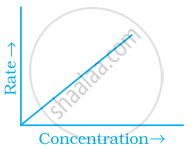 |
|
| (ii) | 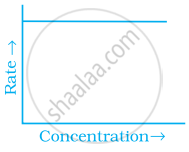 |
(a) 1st order |
| (iii) | 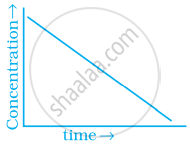 |
(b) Zero-order |
| (iv) | 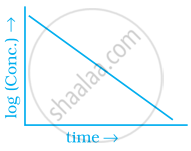 |
For a reaction A + B → products, the rate law is given by: r = `K[A]^(1/2)`. What is the order of reaction?
The rate of a chemical reaction double for every 10° rise in temperature. If the temperature is raised. by 50°C, the rate of relation by about:-
The number of molecules of the reactants taking part in a single step of the reaction is indicative of ______.
The conversion of molecules A to B follow second order kinetics. If concentration of A is increased to three times, how will it affect the rate of formation of B?
For a chemical reaction starting with some initial concentration of reactant At as a function of time (t) is given by the equation,
`1/("A"_"t"^4) = 2 + 1.5 xx 10^-3` t
The rate of disappearance of [A] is ____ × 10-2 M/sec when [A] = 2 M.
[Given: [At] in M and t in sec.]
[Express your answer in terms of 10-2 M /s]
[Round off your answer if required]
