Advertisements
Advertisements
Question
Find the quadratic polynomial, sum of whose zeroes is `sqrt2` and their product is `(1/3)`.
Advertisements
Solution
We can find the quadratic equation if we know the sum of the roots and product of the roots by using the formula
`x^2`-(sum of the roots)x+Product of roots =0
⇒` x^2-sqrt2x+1/3=0`
`⇒ 3x^2-3sqrt2x+1=0`
RELATED QUESTIONS
Find the zeroes of the following quadratic polynomial and verify the relationship between the zeroes and the coefficients:
t2 – 15
Find a quadratic polynomial with the given numbers as the sum and product of its zeroes respectively.
4, 1
Find the zeroes of the following quadratic polynomials and verify the relationship between the zeroes and the coefficients.
`p(x) = x^2 + 2sqrt2x + 6`
If α and β are the zeroes of the quadratic polynomial f(x) = ax2 + bx + c, then evaluate `1/(aalpha + b) + 1/(abeta + b)`.
If a and are the zeros of the quadratic polynomial f(x) = 𝑥2 − 𝑥 − 4, find the value of `1/alpha+1/beta-alphabeta`
If α and β are the zeros of the quadratic polynomial p(x) = 4x2 – 5x – 1, find the value of α2β + αβ2.
If one zero of the quadratic polynomial f(x) = 4x2 – 8kx – 9 is negative of the other, find the value of k.
Find the quadratic polynomial whose zeroes are `2/3` and `(-1)/4`. Verify the relation between the coefficients and the zeroes of the polynomial.
Find the quadratic polynomial whose zeroes are `2/3` and `-1/4` Verify the relation between the coefficients and the zeroes of the polynomial.
If 1 and –2 are two zeroes of the polynomial (x3 – 4x2 – 7x + 10), find its third zero.
Find all the zeroes of (x4 + x3 – 23x2 – 3x + 60), if it is given that two of its zeroes are `sqrt(3)` and `-sqrt(3)`.
If α, β are the zeroes of the polynomial f(x) = x2 + x – 2, then `(α/β - α/β)`.
If x + 2 is a factor of x2 + ax + 2b and a + b = 4, then
If p(x) = axr + bx + c, then –`"b"/"a"` is equal to ______.
Case Study -1
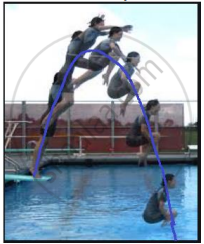
The figure given alongside shows the path of a diver, when she takes a jump from the diving board. Clearly it is a parabola.
Annie was standing on a diving board, 48 feet above the water level. She took a dive into the pool. Her height (in feet) above the water level at any time ‘t’ in seconds is given by the polynomial h(t) such that h(t) = -16t2 + 8t + k.
The zeroes of the polynomial r(t) = -12t2 + (k - 3)t + 48 are negative of each other. Then k is ______.
The number of polynomials having zeroes as –2 and 5 is ______.
The only value of k for which the quadratic polynomial kx2 + x + k has equal zeros is `1/2`
If α and β are the zeros of a polynomial f(x) = px2 – 2x + 3p and α + β = αβ, then p is ______.
Find the zeroes of the quadratic polynomial x2 + 6x + 8 and verify the relationship between the zeroes and the coefficients.
If a quadratic equation \[ ax^{2} + bx + c = 0 \] has roots \[ \alpha = 2 \] and \[ \beta = 3 \], which equation has exactly these roots?
