Advertisements
Advertisements
Question
Find the zeroes of the quadratic polynomial f(x) = 4x2 - 4x - 3 and verify the relation between its zeroes and coefficients.
Advertisements
Solution
We have:
f(x) = 4x2 - 4x - 3
= 4x2 ˗ (6x ˗ 2x) ˗ 3
= 4x2 ˗ 6x + 2x ˗ 3
= 2x (2x ˗ 3) + 1(2x ˗ 3)
= (2x + 1) (2x ˗ 3)
∴ f(x) = 0 ⇒ (2x + 1) (2x ˗ 3) = 0
⇒ 2x + 1= 0 or 2x ˗ 3 = 0`
⇒ `x = (-1)/2 or x =3/2`
So, the zeroes of f(x) are `(-1)/2 and 3/2`
Sum of zeroes = `(-1/2)+(3/2)=(-1+3)/2=2/2=1="-(Coefficient of x)"/(("Coefficient of" x^2))`
Product of zeroes =`((-1)/2)xx(3/2)=(-3)/4= "Constant term"/(("Coefficient of" x^2))`
RELATED QUESTIONS
Find a quadratic polynomial with the given numbers as the sum and product of its zeroes respectively.
`0, sqrt5`
Find the zeroes of the following quadratic polynomials and verify the relationship between the zeroes and the coefficients
`q(x)=sqrt3x^2+10x+7sqrt3`
If α and β are the zeros of the quadratic polynomial f(x) = ax2 + bx + c, then evaluate α - β
If α and β are the zeros of the quadratic polynomial f(x) = ax2 + bx + c, then evaluate α4 + β4
If α and β are the zeros of the quadratic polynomial p(s) = 3s2 − 6s + 4, find the value of `alpha/beta+beta/alpha+2[1/alpha+1/beta]+3alphabeta`
Find the zeroes of the quadratic polynomial `(8x^2 ˗ 4)` and verify the relation between the zeroes and the coefficients
Find the zeroes of the quadratic polynomial `(5y^2 + 10y)` and verify the relation between the zeroes and the coefficients.
If `x =2/3` and x = -3 are the roots of the quadratic equation `ax^2+2ax+5x ` then find the value of a and b.
If α, β, γ are the zeros of the polynomial f(x) = ax3 + bx2 + cx + d, then α2 + β2 + γ2 =
Check whether g(x) is a factor of p(x) by dividing polynomial p(x) by polynomial g(x),
where p(x) = x5 − 4x3 + x2 + 3x +1, g(x) = x3 − 3x + 1
If p(x) = axr + bx + c, then –`"b"/"a"` is equal to ______.
Case Study -1
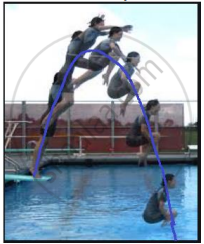
The figure given alongside shows the path of a diver, when she takes a jump from the diving board. Clearly it is a parabola.
Annie was standing on a diving board, 48 feet above the water level. She took a dive into the pool. Her height (in feet) above the water level at any time ‘t’ in seconds is given by the polynomial h(t) such that h(t) = -16t2 + 8t + k.
The zeroes of the polynomial r(t) = -12t2 + (k - 3)t + 48 are negative of each other. Then k is ______.
The below picture are few natural examples of parabolic shape which is represented by a quadratic polynomial. A parabolic arch is an arch in the shape of a parabola. In structures, their curve represents an efficient method of load, and so can be found in bridges and in architecture in a variety of forms.


If the sum of the roots is –p and the product of the roots is `-1/"p"`, then the quadratic polynomial is:
Given that one of the zeroes of the cubic polynomial ax3 + bx2 + cx + d is zero, the product of the other two zeroes is ______.
If one of the zeroes of the cubic polynomial x3 + ax2 + bx + c is –1, then the product of the other two zeroes is ______.
If all the zeroes of a cubic polynomial are negative, then all the coefficients and the constant term of the polynomial have the same sign.
Find the zeroes of the following polynomials by factorisation method and verify the relations between the zeroes and the coefficients of the polynomials:
4x2 – 3x – 1
Find the zeroes of the quadratic polynomial x2 + 6x + 8 and verify the relationship between the zeroes and the coefficients.
The zeroes of the polynomial p(x) = 2x2 – x – 3 are ______.
If α, β are zeroes of quadratic polynomial 5x2 + 5x + 1, find the value of α2 + β2.
