Advertisements
Advertisements
Question
If α, β are the zeroes of the polynomial p(x) = 4x2 – 3x – 7, then `(1/α + 1/β)` is equal to ______.
Options
`7/3`
`(-7)/3`
`3/7`
`(-3)/7`
Advertisements
Solution
If α, β are the zeroes of the polynomial p(x) = 4x2 – 3x – 7, then `(1/α + 1/β)` is equal to `underlinebb((-3)/7)`.
Explanation:
p(x) = 4x2 – 3x – 7 = 0
α, β are the roots of above equation
∴ α + β = `- ("Coefficient of" x)/("Coefficient of" x^2)`
= `-((-3))/4`
= `3/4`
and αβ = `"Constant term"/("Coefficient of" x^2)`
= `(-7)/4`
Now, `1/α + 1/β`
= `(β + α)/(αβ)`
= `(α + β)/(αβ)`
= `(3/4)/((-7)/4)`
= `(-3)/7`
RELATED QUESTIONS
Prove relation between the zeros and the coefficient of the quadratic polynomial ax2 + bx + c
Find the zeroes of the following quadratic polynomial and verify the relationship between the zeroes and the coefficients.
4u2 + 8u
Find the zeroes of the following quadratic polynomials and verify the relationship between the zeroes and the coefficients.
`p(x) = x^2 + 2sqrt2x + 6`
Find the zeroes of the following quadratic polynomials and verify the relationship between the zeroes and the coefficients
`f(x)=x^2-(sqrt3+1)x+sqrt3`
If α, β, γ are the zeros of the polynomial f(x) = ax3 + bx2 + cx + d, the\[\frac{1}{\alpha} + \frac{1}{\beta} + \frac{1}{\gamma} =\]
Basketball and soccer are played with a spherical ball. Even though an athlete dribbles the ball in both sports, a basketball player uses his hands and a soccer player uses his feet. Usually, soccer is played outdoors on a large field and basketball is played indoor on a court made out of wood. The projectile (path traced) of soccer ball and basketball are in the form of parabola representing quadratic polynomial.

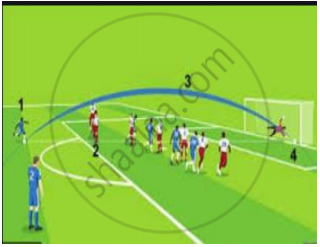
What will be the expression of the polynomial?
Find the zeroes of the following polynomials by factorisation method and verify the relations between the zeroes and the coefficients of the polynomials:
t3 – 2t2 – 15t
If p(x) = x2 + 5x + 6, then p(– 2) is ______.
A quadratic polynomial whose sum and product of zeroes are 2 and – 1 respectively is ______.
Find the zeroes of the polynomial x2 + 4x – 12.
