Advertisements
Advertisements
प्रश्न
If α, β are the zeroes of the polynomial p(x) = 4x2 – 3x – 7, then `(1/α + 1/β)` is equal to ______.
पर्याय
`7/3`
`(-7)/3`
`3/7`
`(-3)/7`
Advertisements
उत्तर
If α, β are the zeroes of the polynomial p(x) = 4x2 – 3x – 7, then `(1/α + 1/β)` is equal to `underlinebb((-3)/7)`.
Explanation:
p(x) = 4x2 – 3x – 7 = 0
α, β are the roots of above equation
∴ α + β = `- ("Coefficient of" x)/("Coefficient of" x^2)`
= `-((-3))/4`
= `3/4`
and αβ = `"Constant term"/("Coefficient of" x^2)`
= `(-7)/4`
Now, `1/α + 1/β`
= `(β + α)/(αβ)`
= `(α + β)/(αβ)`
= `(3/4)/((-7)/4)`
= `(-3)/7`
संबंधित प्रश्न
if α and β are the zeros of ax2 + bx + c, a ≠ 0 then verify the relation between zeros and its cofficients
If α and β are the zeros of the quadratic polynomial f(x) = ax2 + bx + c, then evaluate `a(α^2/β + β^2/α) + b(α/β + β/α)`.
Find the zeroes of the quadratic polynomial 2x2 – 11x + 15 and verify the relation between the zeroes and the coefficients.
If (x+a) is a factor of the polynomial `2x^2 + 2ax + 5x + 10`, find the value of a.
If α, β are the zeroes of the polynomial f(x) = 5x2 – 7x + 1 then `1/α + 1/β = ?`
Case Study -1
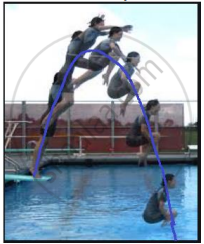
The figure given alongside shows the path of a diver, when she takes a jump from the diving board. Clearly it is a parabola.
Annie was standing on a diving board, 48 feet above the water level. She took a dive into the pool. Her height (in feet) above the water level at any time ‘t’ in seconds is given by the polynomial h(t) such that h(t) = -16t2 + 8t + k.
The zeroes of the polynomial r(t) = -12t2 + (k - 3)t + 48 are negative of each other. Then k is ______.
Find the zeroes of the following polynomials by factorisation method and verify the relations between the zeroes and the coefficients of the polynomials:
`4x^2 + 5sqrt(2)x - 3`
The zeroes of the polynomial p(x) = 25x2 – 49 are ______.
The zeroes of the polynomial p(x) = 2x2 – x – 3 are ______.
For the cubic equation \[ ax^{3} + bx^{2} + cx + d = 0 \] with roots \[ \alpha, \beta, \gamma \], the product of the roots \( \alpha\beta\gamma \) equals:
