Advertisements
Advertisements
प्रश्न
Find the quadratic polynomial, sum of whose zeroes is `sqrt2` and their product is `(1/3)`.
Advertisements
उत्तर
We can find the quadratic equation if we know the sum of the roots and product of the roots by using the formula
`x^2`-(sum of the roots)x+Product of roots =0
⇒` x^2-sqrt2x+1/3=0`
`⇒ 3x^2-3sqrt2x+1=0`
संबंधित प्रश्न
Find the zeros of the quadratic polynomial 4x2 - 9 and verify the relation between the zeros and its coffiecents.
Find the zeroes of the following quadratic polynomial and verify the relationship between the zeroes and the coefficients.
6x2 – 3 – 7x
Find a quadratic polynomial with the given numbers as the sum and product of its zeroes respectively.
1, 1
If the zeroes of the polynomial x3 – 3x2 + x + 1 are a – b, a, a + b, find a and b
Find all zeroes of the polynomial `(2x^4 - 9x^3 + 5x^2 + 3x - 1)` if two of its zeroes are `(2 + sqrt3)` and `(2 - sqrt3)`
If α and β are the zeros of the quadratic polynomial f(x) = ax2 + bx + c, then evaluate `beta/(aalpha + b) + alpha/(abeta + b)`.
If α and β are the zeros of the quadratic polynomial p(y) = 5y2 – 7y + 1, find the value of `1/α + 1/β`.
If the sum of the zeros of the quadratic polynomial f(t) = kt2 + 2t + 3k is equal to their product, find the value of k.
If α and β are the zeroes of the polynomial f(x) = x2 + px + q, form a polynomial whose zeroes are (α + β)2 and (α − β)2.
If 3 and –3 are two zeroes of the polynomial (x4 + x3 – 11x2 – 9x + 18), find all the zeroes of the given polynomial.
If α, β are the zeroes of the polynomial f(x) = 5x2 – 7x + 1 then `1/α + 1/β = ?`
Case Study -1
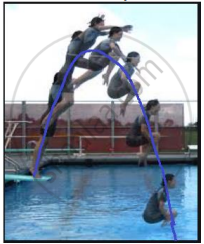
The figure given alongside shows the path of a diver, when she takes a jump from the diving board. Clearly it is a parabola.
Annie was standing on a diving board, 48 feet above the water level. She took a dive into the pool. Her height (in feet) above the water level at any time ‘t’ in seconds is given by the polynomial h(t) such that h(t) = -16t2 + 8t + k.
The zeroes of the polynomial r(t) = -12t2 + (k - 3)t + 48 are negative of each other. Then k is ______.
If two of the zeroes of a cubic polynomial are zero, then it does not have linear and constant terms.
Find the zeroes of the following polynomials by factorisation method and verify the relations between the zeroes and the coefficients of the polynomials:
5t2 + 12t + 7
Given that `sqrt(2)` is a zero of the cubic polynomial `6x^3 + sqrt(2)x^2 - 10x - 4sqrt(2)`, find its other two zeroes.
The zeroes of the quadratic polynomial x2 + 99x + 127 are ______.
If p(x) = x2 + 5x + 6, then p(– 2) is ______.
If α, β are zeroes of quadratic polynomial 5x2 + 5x + 1, find the value of α–1 + β–1.
For the cubic equation \[ ax^{3} + bx^{2} + cx + d = 0 \] with roots \[ \alpha, \beta, \gamma \], the sum of the roots \( \alpha + \beta + \gamma \) is:
