Advertisements
Advertisements
Question
Find the equation of the perpendicular drawn from the point P (−1, 3, 2) to the line \[\overrightarrow{r} = \left( 2 \hat{j} + 3 \hat{k} \right) + \lambda\left( 2 \hat{i} + \hat{j} + 3 \hat{k} \right) .\] Also, find the coordinates of the foot of the perpendicular from P.
Advertisements
Solution
Let L be the foot of the perpendicular drawn from the point P ( -1, 3, 2) to the line \[\overrightarrow{r} = \left( 2 \hat{j} + 3 \hat{k} \right) + \lambda\left( 2 \hat{i} + \hat{j} + 3 \hat{k} \right) .\]
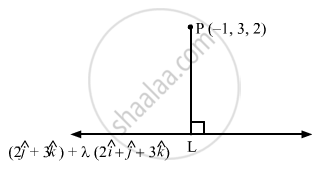
Let the position vector L be \[\overrightarrow{r} = \left( 2 \hat{j} + 3 \hat{k} \right) + \lambda\left( 2 \hat{i} + \hat{j} + 3 \hat{k} \right) = 2\lambda \hat{i} + \left( 2 + \lambda \right) \hat{j} + \left( 3 + 3\lambda \right) \hat{k} \] ...........(1)
Now,
\[\overrightarrow{PL} = \text{ Position vector of L - Position vector of P } \]
\[ \Rightarrow \overrightarrow{PL} = \left\{ 2\lambda \hat{i} + \left( 2 + \lambda \right) \hat{j} + \left( 3 + 3\lambda \right) \hat{k} \right\} - \left( - \hat{i} + 3 \hat{j} + 2 \hat{k} \right)\]
\[ \Rightarrow \overrightarrow{PL} = \left( 2\lambda + 1 \right) \hat{i} + \left( \lambda - 1 \right) \hat{j} + \left( 3\lambda + 1 \right) \hat{k} . . . (2)\]
Since \[\overrightarrow{PL}\] is perpendicular to the given line, which is parallel to \[\overrightarrow{b} = 2 \hat{i} + \hat{j} + 3 \hat{k} \]
we have ,
\[\overrightarrow{PL} . \overrightarrow{b} = 0\]
\[ \Rightarrow \left\{ \left( 2\lambda + 1 \right) \hat{i} + \left( \lambda - 1 \right) \hat{j} + \left( 3\lambda + 1 \right) \hat{k} \right\} . \left( 2 \hat{i} + \hat{j} + 3 \hat{k} \right) = 0 \]
\[ \Rightarrow 2\left( 2\lambda + 1 \right) + 1\left( \lambda - 1 \right) + 3\left( 3\lambda + 1 \right) = 0\]
\[ \Rightarrow \lambda = - \frac{2}{7}\]
Substituting \[ \Rightarrow \lambda = - \frac{2}{7}\] in (1),
we get the position vector of L as \[- \frac{4}{7} \hat{i} + \frac{12}{7} \hat{j} + \frac{15}{7} \hat{k} \] So, the coordinates of the foot of the perpendicular from P to the given line is L \[\left( - \frac{4}{7}, \frac{12}{7}, \frac{15}{7} \right)\]
Substituting \[\lambda = - \frac{2}{7}\] in (2), we get \[\overrightarrow{PL} = \frac{3}{7} \hat{i} - \frac{9}{7} \hat{j} + \frac{1}{7} \hat{k} \]
Equation of the perpendicular drawn from P to the given line is
\[\overrightarrow{r} = \text{ Position vector of P } + \lambda\left( \vec{PL} \right)\]
\[ = \left( - \hat{i} + 3 \hat{j} + 2 \hat{k} \right) + \lambda\left( 3 \hat{i} - 9 \hat{j} + \hat{k} \right)\]
APPEARS IN
RELATED QUESTIONS
Find the vector and cartesian equations of the line passing through the point (2, 1, 3) and perpendicular to the lines
`(x-1)/1=(y-2)/2=(z-3)/3 and x/(-3)=y/2=z/5`
Let `A(bara)` and `B(barb)` be any two points in the space and `R(barr)` be a point on the line segment AB dividing it internally in the ratio m : n, then prove that `bar r=(mbarb+nbara)/(m+n)`. Hence find the position vector of R which divides the line segment joining the points A(1, –2, 1) and B(1, 4, –2) internally in the ratio 2 : 1.
Find the equation of the line in vector and in Cartesian form that passes through the point with position vector `2hati -hatj+4hatk` and is in the direction `hati + 2hatj - hatk`.
The Cartesian equation of a line is `(x-5)/3 = (y+4)/7 = (z-6)/2` Write its vector form.
Find the vector and cartesian equations of the line through the point (5, 2, −4) and which is parallel to the vector \[3 \hat{i} + 2 \hat{j} - 8 \hat{k} .\]
Find the vector equation of a line passing through the point with position vector \[\hat{i} - 2 \hat{j} - 3 \hat{k}\] and parallel to the line joining the points with position vectors \[\hat{i} - \hat{j} + 4 \hat{k} \text{ and } 2 \hat{i} + \hat{j} + 2 \hat{k} .\] Also, find the cartesian equivalent of this equation.
The cartesian equation of a line are 3x + 1 = 6y − 2 = 1 − z. Find the fixed point through which it passes, its direction ratios and also its vector equation.
Show that the three lines with direction cosines \[\frac{12}{13}, \frac{- 3}{13}, \frac{- 4}{13}; \frac{4}{13}, \frac{12}{13}, \frac{3}{13}; \frac{3}{13}, \frac{- 4}{13}, \frac{12}{13}\] are mutually perpendicular.
Show that the line through the points (4, 7, 8) and (2, 3, 4) is parallel to the line through the points (−1, −2, 1) and, (1, 2, 5).
Show that the lines \[\frac{x - 5}{7} = \frac{y + 2}{- 5} = \frac{z}{1} \text { and }\frac{x}{1} = \frac{y}{2} = \frac{z}{3}\] are perpendicular to each other.
Find the equation of the line passing through the point (1, 2, −4) and parallel to the line \[\frac{x - 3}{4} = \frac{y - 5}{2} = \frac{z + 1}{3} .\]
Show that the lines \[\frac{x - 5}{7} = \frac{y + 2}{- 5} = \frac{z}{1} \text{ and } \frac{x}{1} = \frac{y}{2} = \frac{z}{3}\] are perpendicular to each other.
If the coordinates of the points A, B, C, D be (1, 2, 3), (4, 5, 7), (−4, 3, −6) and (2, 9, 2) respectively, then find the angle between the lines AB and CD.
Find the direction cosines of the line
\[\frac{x + 2}{2} = \frac{2y - 7}{6} = \frac{5 - z}{6}\] Also, find the vector equation of the line through the point A(−1, 2, 3) and parallel to the given line.
Show that the lines \[\frac{x - 1}{3} = \frac{y + 1}{2} = \frac{z - 1}{5} \text{ and } \frac{x + 2}{4} = \frac{y - 1}{3} = \frac{z + 1}{- 2}\] do not intersect.
Determine whether the following pair of lines intersect or not:
\[\frac{x - 5}{4} = \frac{y - 7}{4} = \frac{z + 3}{- 5} and \frac{x - 8}{7} = \frac{y - 4}{1} = \frac{3 - 5}{3}\]
Find the foot of the perpendicular drawn from the point A (1, 0, 3) to the joint of the points B (4, 7, 1) and C (3, 5, 3).
Find the foot of the perpendicular from (0, 2, 7) on the line \[\frac{x + 2}{- 1} = \frac{y - 1}{3} = \frac{z - 3}{- 2} .\]
Find the coordinates of the foot of perpendicular drawn from the point A(1, 8, 4) to the line joining the points B(0, −1, 3) and C(2, −3, −1).
Find the shortest distance between the following pairs of lines whose vector equations are: \[\overrightarrow{r} = \left( 3 \hat{i} + 5 \hat{j} + 7 \hat{k} \right) + \lambda\left( \hat{i} - 2 \hat{j} + 7 \hat{k} \right) \text{ and } \overrightarrow{r} = - \hat{i} - \hat{j} - \hat{k} + \mu\left( 7 \hat{i} - 6 \hat{j} + \hat{k} \right)\]
Find the shortest distance between the following pairs of lines whose cartesian equations are: \[\frac{x - 1}{2} = \frac{y - 2}{3} = \frac{z - 3}{4} and \frac{x - 2}{3} = \frac{y - 3}{4} = \frac{z - 5}{5}\]
Find the shortest distance between the lines \[\overrightarrow{r} = \left( \hat{i} + 2 \hat{j} + \hat{k} \right) + \lambda\left( \hat{i} - \hat{j} + \hat{k} \right) \text{ and } , \overrightarrow{r} = 2 \hat{i} - \hat{j} - \hat{k} + \mu\left( 2 \hat{i} + \hat{j} + 2 \hat{k} \right)\]
Find the shortest distance between the lines \[\frac{x + 1}{7} = \frac{y + 1}{- 6} = \frac{z + 1}{1} \text{ and } \frac{x - 3}{1} = \frac{y - 5}{- 2} = \frac{z - 7}{1}\]
Write the formula for the shortest distance between the lines
\[\overrightarrow{r} = \overrightarrow{a_1} + \lambda \overrightarrow{b} \text{ and } \overrightarrow{r} = \overrightarrow{a_2} + \mu \overrightarrow{b} .\]
Find the angle between the lines
\[\vec{r} = \left( 2 \hat{i} - 5 \hat{j} + \hat{k} \right) + \lambda\left( 3 \hat{i} + 2 \hat{j} + 6 \hat{k} \right)\] and \[\vec{r} = 7 \hat{i} - 6 \hat{k} + \mu\left( \hat{i} + 2 \hat{j} + 2 \hat{k} \right)\]
The lines \[\frac{x}{1} = \frac{y}{2} = \frac{z}{3} \text { and } \frac{x - 1}{- 2} = \frac{y - 2}{- 4} = \frac{z - 3}{- 6}\]
The shortest distance between the lines \[\frac{x - 3}{3} = \frac{y - 8}{- 1} = \frac{z - 3}{1} \text{ and }, \frac{x + 3}{- 3} = \frac{y + 7}{2} = \frac{z - 6}{4}\]
Find the equation of a plane which passes through the point (3, 2, 0) and contains the line \[\frac{x - 3}{1} = \frac{y - 6}{5} = \frac{z - 4}{4}\].
Find the value of λ for which the following lines are perpendicular to each other:
`(x - 5)/(5 lambda + 2 ) = ( 2 - y )/5 = (1 - z ) /-1 ; x /1 = ( y + 1/2)/(2 lambda ) = ( z -1 ) / 3`
If the lines represented by kx2 − 3xy + 6y2 = 0 are perpendicular to each other, then
The equation 4x2 + 4xy + y2 = 0 represents two ______
Find the separate equations of the lines given by x2 + 2xy tan α − y2 = 0
The equation of line passing through (3, -1, 2) and perpendicular to the lines `overline("r")=(hat"i"+hat"j"-hat"k")+lambda(2hat"i"-2hat"j"+hat"k")` and `overline("r")=(2hat"i"+hat"j"-3hat"k")+mu(hat"i"-2hat"j"+2hat"k")` is ______.
Find the vector equation of the lines passing through the point having position vector `(-hati - hatj + 2hatk)` and parallel to the line `vecr = (hati + 2hatj + 3hatk) + λ(3hati + 2hatj + hatk)`.
For the point \[(5,2,-4)\], what is its position vector \[\vec{a}\]?
What is the parametric form of the line through \[(5,2,-4)\] with direction ratios \[3,2,-8\]?
