Advertisements
Advertisements
Question
Explain the following reaction with the balanced equation.
Sulphur burns in air
Advertisements
Solution
Sulphur burns in air to form sulphur dioxide.
\[\ce{\underset{\text{Sulphur}}{S} + \underset{\text{Oxygen}}{O2} -> \underset{\text{Sulphur dioxide}}{SO2}}\]
APPEARS IN
RELATED QUESTIONS
What do you observe when dilute sulphuric acid is added to granulated zinc?
What do you observe when a few pieces of iron are dropped in a blue solution of copper sulphate?
What do you observe when silver nitrate is added to a solution of sodium chloride?
How will you obtain Magnesium oxide from magnesium.
Also give balanced equations for the reactions
With reference to Water explain with suitable examples of how the reactivity of the metals could be differentiated.
Select the correct answer for the statement given below:
A neutral oxide which does not react with an acid or a base to give salt and water.
Complete the statement by filling in the blank with the correct word:
The metal which reacts with steam and the reaction is reversible is ________.
In preparation of Aqua regia hydrochloric acid and _______ acid are mixed.
Explain the following reaction with the balanced equation.
Sodium burns in air
Explain the following reaction with the balanced equation.
Reaction of aluminium with oxygen
Observe the following diagram and identify the type of reaction and write observation.
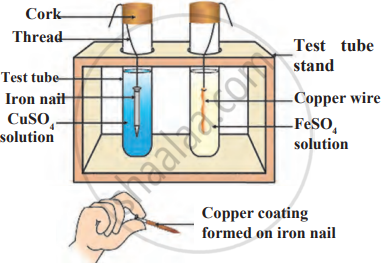
Which of the following is the correct arrangement of the given metals in ascending order of their reactivity?
Zinc, Iron, Magnesium, Sodium
Which among the following alloys contain mercury as one of its constituents?
A metal that exists as a liquid at room temperature is obtained by heating its sulphide in the presence of air. Identify the metal and its ore and give the reaction involved.
An element A reacts with water to form a compound B which is used in white washing. The compound B on heating forms an oxide C which on treatment with water gives back B. Identify A, B and C and give the reactions involved.
A metal M does not liberate hydrogen from acids but reacts with oxygen to give a black colour product. Identify M and black coloured product and also explain the reaction of M with oxygen.
An element A burns with golden flame in air. It reacts with another element B, atomic number 17 to give a product C. An aqueous solution of product C on electrolysis gives a compound D and liberates hydrogen. Identify A, B, C and D. Also write down the equations for the reactions involved.
