Advertisements
Advertisements
Question
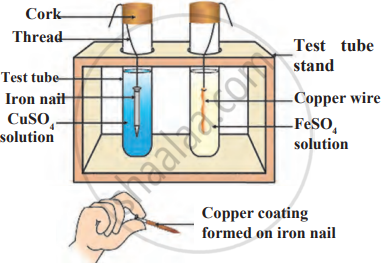
What do you observe when a few pieces of iron are dropped in a blue solution of copper sulphate?
Advertisements
Solution
When a few pieces of iron are dropped into a blue coloured copper sulphate solution, the blue colour of the solution fades and eventually turns into light green.
\[\ce{Fe + CuSO4_{(aq)}-> FeSO4 + Cu}\]
APPEARS IN
RELATED QUESTIONS
Write a chemical equation for the event.
Iron filings are dropped in aqueous solution of copper sulphate.
Write the chemical equation for the event.
A reaction was brought about between ferric oxide and aluminium.
Select the correct answer for the statement given below:
The catalyst used in the catalytic reaction involving the reactants nitrogen and hydrogen.
Complete the statement by filling in the blank with the correct word:
The metal which reacts with steam and the reaction is reversible is ________.
Explain the following reaction with the balanced equation.
Magnesium reacts with dil HCl
Observe the following diagram and identify the type of reaction and write observation.
Which among the following statements is incorrect for magnesium metal?
Compound X and aluminium are used to join railway tracks.
- Identify the compound X
- Name the reaction
- Write down its reaction.
An element A reacts with water to form a compound B which is used in white washing. The compound B on heating forms an oxide C which on treatment with water gives back B. Identify A, B and C and give the reactions involved.
Give the steps involved in the extraction of metals of low and medium reactivity from their respective sulphide ores.
