Advertisements
Advertisements
Question
Explain the following reaction with the balanced equation.
Sodium burns in air
Advertisements
Solution
On burning, sodium metal combines with oxygen in the air to form sodium oxide.
\[\ce{\underset{\text{Sodium}}{4Na_{(s)}} + \underset{\text{Oxygen}}{O_{2(g)}} -> \underset{\text{Sodium oxide}}{2Na2O_{(s)}}}\]
APPEARS IN
RELATED QUESTIONS
Give one example each of which illustrates the following characteristics of a chemical reaction:
evolution of a gas
How will you obtain Silver chloride from silver nitrate.
Also give balanced equations for the reactions
What is meant by the metal reactivity series ? State its importance, (any two points).
Write a chemical equation for the event.
Iron filings are dropped in aqueous solution of copper sulphate.
Write chemical equation for the event.
Electrolysis of alumina is done.
Write a chemical equation for the following event.
Zinc oxide is dissolved in dilute hydrochloric acid.
Give a balanced equation for the reversible catalytic reaction involving nitrogen as one of the reactants.
Select the correct answer for the statement given below:
The catalyst used in the catalytic reaction involving the reactants nitrogen and hydrogen.
Select the correct answer for the statement given below:
A neutral oxide which does not react with an acid or a base to give salt and water.
Complete the statement by filling in the blank with the correct word:
The metal which reacts with steam and the reaction is reversible is ________.
Give a balanced equation for the following type of reaction:
A displacement reaction in which a metal above hydrogen in the reactivity series, displaces another metal from the solution of its compound.
Explain the following reaction with the balanced equation.
Reaction of aluminium with oxygen
Explain the following reaction with the balanced equation.
Sulphur burns in air
Observe the following diagram and identify the type of reaction and write observation.
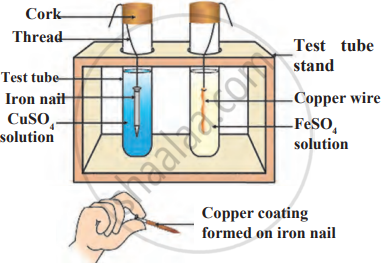
Which of the following is the correct arrangement of the given metals in ascending order of their reactivity?
Zinc, Iron, Magnesium, Sodium
Which among the following alloys contain mercury as one of its constituents?
Of the three metals X, Y and Z. X reacts with cold water, Y with hot water and Z with steam only. Identify X, Y and Z and also arrange them in order of increasing reactivity.
Three metal samples of magnesium, aluminium and iron were taken and rubbed with sandpaper. These samples were then put separately in test tubes containing dilute hydrochloric acid. Thermometers were also suspended in each test tube so that their bulbs dipped in the acid. The rate of formation of bubbles was observed. The above activity was repeated with dilute nitric acid and the observations were recorded.
Answer the following questions:
(i) When the activity was done with dilute hydrochloric acid, then in which one of the test tubes was the rate of formation of bubbles the fastest and the thermometer showed the highest temperature?
(ii) Which metal did not react with dilute hydrochloric acid? Give reason.
(iii) Why is hydrogen gas not evolved when a metal reacts with dilute nitric acid? Name the ultimate products formed in the reaction.
OR
Name the type of reaction on the basis of which the reactivity of metals is decided. You have two metals X and Y. How would you decide which is more reactive than the other?
