Advertisements
Advertisements
Question
State what is meant by the ‘reactivity series of metals’
Advertisements
Solution
Activity series of metals:
“Is a series of arrangements of metals in decreasing order of their reactivity.”
i.e. metals at the top are most reactive and least reactive metals are at the bottom of the series. The metal above is more reactive than the lower metal. In other words, K is more reactive than all the metals below it and Na is more reactive than all the metals below it.
APPEARS IN
RELATED QUESTIONS
What do you observe when magnesium ribbon is burnt in oxygen?
Select the correct answer for the statement given below:
The catalyst used in the catalytic reaction involving the reactants nitrogen and hydrogen.
Select the correct answer for the statement given below:
A neutral oxide which does not react with an acid or a base to give salt and water.
In preparation of Aqua regia hydrochloric acid and _______ acid are mixed.
Explain the following reaction with the balanced equation.
Sodium burns in air
Explain the following reaction with the balanced equation.
Sulphur burns in air
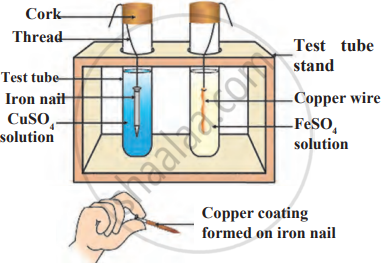
Observe the following diagram and identify the type of reaction and write observation.
Which among the following statements is incorrect for magnesium metal?
An element A reacts with water to form a compound B which is used in white washing. The compound B on heating forms an oxide C which on treatment with water gives back B. Identify A, B and C and give the reactions involved.
Explain the following
- Reactivity of Al decreases if it is dipped in HNO3
- Carbon cannot reduce the oxides of Na or Mg
- NaCl is not a conductor of electricity in solid state whereas it does conduct electricity in aqueous solution as well as in molten state
- Iron articles are galvanised.
- Metals like Na, K, Ca and Mg are never found in their free state in nature.
