Advertisements
Advertisements
प्रश्न
State what is meant by the ‘reactivity series of metals’
Advertisements
उत्तर
Activity series of metals:
“Is a series of arrangements of metals in decreasing order of their reactivity.”
i.e. metals at the top are most reactive and least reactive metals are at the bottom of the series. The metal above is more reactive than the lower metal. In other words, K is more reactive than all the metals below it and Na is more reactive than all the metals below it.
APPEARS IN
संबंधित प्रश्न
What do you observe when silver nitrate is added to a solution of sodium chloride?
How will you obtain Silver chloride from silver nitrate.
Also give balanced equations for the reactions
With reference to Water explain with suitable examples of how the reactivity of the metals could be differentiated.
With reference to Acid explain with a suitable example of how the reactivity of the metals could be differentiated.
Select the correct answer for the statement given below:
A neutral oxide which does not react with an acid or a base to give salt and water.
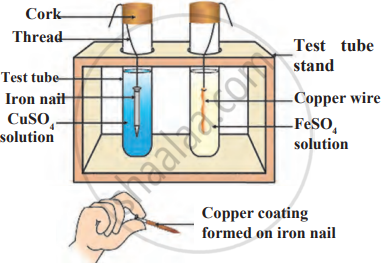
Observe the following diagram and identify the type of reaction and write observation.
Which among the following statements is incorrect for magnesium metal?
Which among the following alloys contain mercury as one of its constituents?
A metal M does not liberate hydrogen from acids but reacts with oxygen to give a black colour product. Identify M and black coloured product and also explain the reaction of M with oxygen.
Explain the following
- Reactivity of Al decreases if it is dipped in HNO3
- Carbon cannot reduce the oxides of Na or Mg
- NaCl is not a conductor of electricity in solid state whereas it does conduct electricity in aqueous solution as well as in molten state
- Iron articles are galvanised.
- Metals like Na, K, Ca and Mg are never found in their free state in nature.
