Advertisements
Advertisements
Question
Fill in the blank
When a piece of copper is added to silver nitrate solution, it turns ............in colour.
Advertisements
Solution
When a piece of copper is added to silver nitrate solution, it turns blue in colour.
APPEARS IN
RELATED QUESTIONS
Give one example each of which illustrates the following characteristics of a chemical reaction:
evolution of a gas
What is meant by the metal reactivity series ? State its importance, (any two points).
State what is meant by the ‘reactivity series of metals’
With reference to Acid explain with a suitable example of how the reactivity of the metals could be differentiated.
Select the correct answer for the statement given below:
A neutral oxide which does not react with an acid or a base to give salt and water.
Observe the following diagram and identify the type of reaction and write observation.
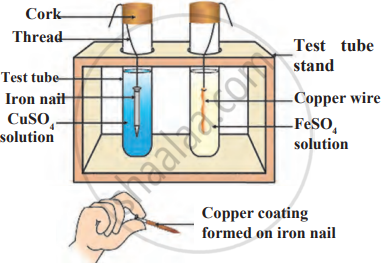
A metal A, which is used in thermite process, when heated with oxygen gives an oxide B, which is amphoteric in nature. Identify A and B. Write down the reactions of oxide B with HCl and NaOH.
A metal M does not liberate hydrogen from acids but reacts with oxygen to give a black colour product. Identify M and black coloured product and also explain the reaction of M with oxygen.
Explain the following
- Reactivity of Al decreases if it is dipped in HNO3
- Carbon cannot reduce the oxides of Na or Mg
- NaCl is not a conductor of electricity in solid state whereas it does conduct electricity in aqueous solution as well as in molten state
- Iron articles are galvanised.
- Metals like Na, K, Ca and Mg are never found in their free state in nature.
Arrange the following as per the instruction given in the bracket:
Al, K, Mg, Ca (decreasing order of its reactivity)
