Advertisements
Advertisements
Question
Write chemical equation for the event.
Aluminium came in contact with air.
Advertisements
Solution
Aluminum came in contact with air.
Aluminum is a very reactive metal. The outer surface of the metal is actually covered by a very thin layer of oxide which keeps the metal protected from the air. But when the oxide layer is damaged, aluminum comes in contact with the air. It is easily attacked by air. Then aluminum starts reacting with the oxygen. It will burn as bright white flame to change into aluminum(III) oxide.
Chemical Equation:
APPEARS IN
RELATED QUESTIONS
Give one example each of which illustrates the following characteristics of a chemical reaction:
evolution of a gas
What do you observe when dilute sulphuric acid is added to granulated zinc?
What do you observe when silver nitrate is added to a solution of sodium chloride?
What do you observe when ferrous sulphate solution is added to an aqueous solution of sodium hydroxide.
Write chemical equation for the event.
Electrolysis of alumina is done.
Divide the metals Cu, Zn, Ca, Mg, Fe, Na, Li into three groups, namely reactive metals, moderately reactive metals and less reactive metals.
With reference to Acid explain with a suitable example of how the reactivity of the metals could be differentiated.
Select the correct answer for the statement given below:
The catalyst used in the catalytic reaction involving the reactants nitrogen and hydrogen.
Complete the statement by filling in the blank with the correct word:
The metal which reacts with steam and the reaction is reversible is ________.
Observe the following diagram and identify the type of reaction and write observation.
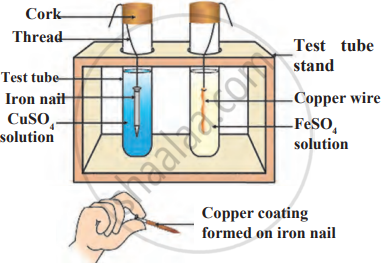
Which of the following is the correct arrangement of the given metals in ascending order of their reactivity?
Zinc, Iron, Magnesium, Sodium
An element A reacts with water to form a compound B which is used in white washing. The compound B on heating forms an oxide C which on treatment with water gives back B. Identify A, B and C and give the reactions involved.
A metal M does not liberate hydrogen from acids but reacts with oxygen to give a black colour product. Identify M and black coloured product and also explain the reaction of M with oxygen.
Explain the following
- Reactivity of Al decreases if it is dipped in HNO3
- Carbon cannot reduce the oxides of Na or Mg
- NaCl is not a conductor of electricity in solid state whereas it does conduct electricity in aqueous solution as well as in molten state
- Iron articles are galvanised.
- Metals like Na, K, Ca and Mg are never found in their free state in nature.
An element A burns with golden flame in air. It reacts with another element B, atomic number 17 to give a product C. An aqueous solution of product C on electrolysis gives a compound D and liberates hydrogen. Identify A, B, C and D. Also write down the equations for the reactions involved.
Metal ‘A’ has electronic configuration 2, 8, 1 and metal ‘B’ has electronic configuration 2, 8, 8, 2. Out of these, which metal is more reactive? Write the reaction of this metal with dilute HCl acid.
Three metal samples of magnesium, aluminium and iron were taken and rubbed with sandpaper. These samples were then put separately in test tubes containing dilute hydrochloric acid. Thermometers were also suspended in each test tube so that their bulbs dipped in the acid. The rate of formation of bubbles was observed. The above activity was repeated with dilute nitric acid and the observations were recorded.
Answer the following questions:
(i) When the activity was done with dilute hydrochloric acid, then in which one of the test tubes was the rate of formation of bubbles the fastest and the thermometer showed the highest temperature?
(ii) Which metal did not react with dilute hydrochloric acid? Give reason.
(iii) Why is hydrogen gas not evolved when a metal reacts with dilute nitric acid? Name the ultimate products formed in the reaction.
OR
Name the type of reaction on the basis of which the reactivity of metals is decided. You have two metals X and Y. How would you decide which is more reactive than the other?
