Advertisements
Advertisements
Question
Classify the following metals based on their reactivity.
Cu, Zn, Ca, Mg, Fe, Na, Li, Hg
| More reactive | Moderately reactive | Less reactive |
Advertisements
Solution
| More reactive | Moderately reactive | Less reactive |
| Ca | Zn | Cu |
| Na | Mg | Hg |
| Li | Fe |
APPEARS IN
RELATED QUESTIONS
What do you observe when dilute sulphuric acid is added to granulated zinc?
What do you observe when a few pieces of iron are dropped in a blue solution of copper sulphate?
What do you observe when ferrous sulphate solution is added to an aqueous solution of sodium hydroxide.
Fill in the blank
When a piece of copper is added to silver nitrate solution, it turns ............in colour.
How will you obtain Zinc chloride from zinc.
Also give balanced equations for the reactions
What do you observe when magnesium ribbon is burnt in oxygen?
What is meant by the metal reactivity series ? State its importance, (any two points).
Write chemical equation for the event.
Aluminium came in contact with air.
Write chemical equation for the event.
Electrolysis of alumina is done.
Divide the metals Cu, Zn, Ca, Mg, Fe, Na, Li into three groups, namely reactive metals, moderately reactive metals and less reactive metals.
With reference to Acid explain with a suitable example of how the reactivity of the metals could be differentiated.
Explain the following reaction with the balanced equation.
Reaction of aluminium with oxygen
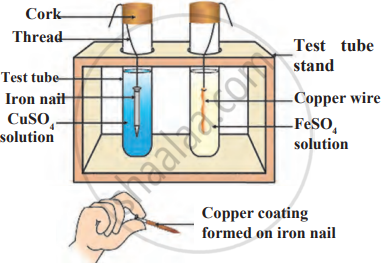
Observe the following diagram and identify the type of reaction and write observation.
Which of the following is the correct arrangement of the given metals in ascending order of their reactivity?
Zinc, Iron, Magnesium, Sodium
Compound X and aluminium are used to join railway tracks.
- Identify the compound X
- Name the reaction
- Write down its reaction.
A metal A, which is used in thermite process, when heated with oxygen gives an oxide B, which is amphoteric in nature. Identify A and B. Write down the reactions of oxide B with HCl and NaOH.
