Advertisements
Advertisements
Question
How will you obtain Magnesium oxide from magnesium.
Also give balanced equations for the reactions
Advertisements
Solution
Magnesium when burnt in air (oxygen) Magnesium oxide is formed
\[\ce{2Mg + O2->[heat] 2Mgo}\]
APPEARS IN
RELATED QUESTIONS
What do you observe when silver nitrate is added to a solution of sodium chloride?
How will you obtain Silver chloride from silver nitrate.
Also give balanced equations for the reactions
How will you obtain Zinc chloride from zinc.
Also give balanced equations for the reactions
Write chemical equation for the event.
Electrolysis of alumina is done.
Divide the metals Cu, Zn, Ca, Mg, Fe, Na, Li into three groups, namely reactive metals, moderately reactive metals and less reactive metals.
Select the correct answer for the statement given below:
A neutral oxide which does not react with an acid or a base to give salt and water.
Complete the statement by filling in the blank with the correct word:
The metal which reacts with steam and the reaction is reversible is ________.
In preparation of Aqua regia hydrochloric acid and _______ acid are mixed.
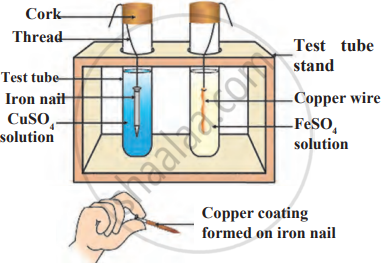
Observe the following diagram and identify the type of reaction and write observation.
Which of the following is the correct arrangement of the given metals in ascending order of their reactivity?
Zinc, Iron, Magnesium, Sodium
