Advertisements
Advertisements
प्रश्न
How will you obtain Magnesium oxide from magnesium.
Also give balanced equations for the reactions
Advertisements
उत्तर
Magnesium when burnt in air (oxygen) Magnesium oxide is formed
\[\ce{2Mg + O2->[heat] 2Mgo}\]
APPEARS IN
संबंधित प्रश्न
How will you obtain Silver chloride from silver nitrate.
Also give balanced equations for the reactions
How will you obtain Zinc chloride from zinc.
Also give balanced equations for the reactions
What do you observe when magnesium ribbon is burnt in oxygen?
Write a chemical equation for the event.
Iron filings are dropped in aqueous solution of copper sulphate.
Write the chemical equation for the event.
A reaction was brought about between ferric oxide and aluminium.
Explain the following reaction with the balanced equation.
Reaction of aluminium with oxygen
Observe the following diagram and identify the type of reaction and write observation.
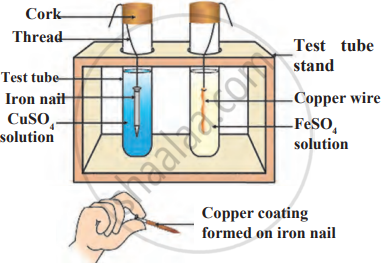
Which of the following is the correct arrangement of the given metals in ascending order of their reactivity?
Zinc, Iron, Magnesium, Sodium
Which among the following alloys contain mercury as one of its constituents?
An element A burns with golden flame in air. It reacts with another element B, atomic number 17 to give a product C. An aqueous solution of product C on electrolysis gives a compound D and liberates hydrogen. Identify A, B, C and D. Also write down the equations for the reactions involved.
