Advertisements
Advertisements
Question
Write chemical equation for the event.
Electrolysis of alumina is done.
Advertisements
Solution 1
The electrolysis of alumina is carried out in a steel tank lined inside with graphite. The graphite lining serves as cathode. Anode is also made up of graphite rods hanging in the molten mass. The electrolyte consists of alumina dissolved in fused Cryolite(Na3AlF6) and Fluorspar(CaF2). Cryolite lowers the melting point of alumina and fluorspar increases the fluidity of the mass so that the liberated aluminum metal may sink at the bottom of the cell. When electric current is passed through this mixture, the aluminum is collected at the cathode in molten state and sinks at the bottom.
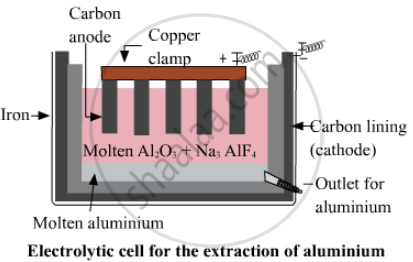
Ionization of Alumina:2Al2O3 → 6O-2 + 4Al+3
Reaction at Cathode: 4Al+3 + 12e- → 4Al
Reaction at Anode: 6O-2 → 3O2 + 12e-, C + O2 → CO2
Solution 2
When electrolysis of alumina is done, aluminium is formed at the cathode and oxygen gas liberated at the anode.
Cathode:
\[\ce{Al^{3+} + 3e^- -> Al_{(l)}}\] (Reduction)
Anode:
\[\ce{2O^2- -> O_{2(g)} + 4e^-}\] (Oxidation)
APPEARS IN
RELATED QUESTIONS
What do you observe when a few pieces of iron are dropped in a blue solution of copper sulphate?
Fill in the blank
When a piece of copper is added to silver nitrate solution, it turns ............in colour.
Write chemical equation for the event.
Aluminium came in contact with air.
Write a chemical equation for the event.
Iron filings are dropped in aqueous solution of copper sulphate.
Write the chemical equation for the event.
A reaction was brought about between ferric oxide and aluminium.
Divide the metals Cu, Zn, Ca, Mg, Fe, Na, Li into three groups, namely reactive metals, moderately reactive metals and less reactive metals.
With reference to Water explain with suitable examples of how the reactivity of the metals could be differentiated.
With reference to Acid explain with a suitable example of how the reactivity of the metals could be differentiated.
Give a balanced equation for the reversible catalytic reaction involving nitrogen as one of the reactants.
Classify the following metals based on their reactivity.
Cu, Zn, Ca, Mg, Fe, Na, Li, Hg
| More reactive | Moderately reactive | Less reactive |
Explain the following reaction with the balanced equation.
Sodium burns in air
Explain the following reaction with the balanced equation.
Magnesium reacts with dil HCl
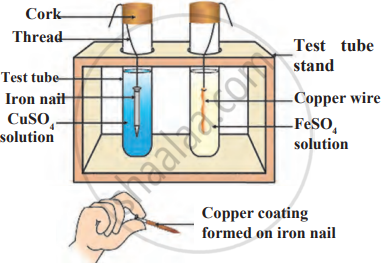
Observe the following diagram and identify the type of reaction and write observation.
A metal A, which is used in thermite process, when heated with oxygen gives an oxide B, which is amphoteric in nature. Identify A and B. Write down the reactions of oxide B with HCl and NaOH.
A solution of CuSO4 was kept in an iron pot. After few days the iron pot was found to have a number of holes in it. Explain the reason in terms of reactivity. Write the equation of the reaction involved.
Give the steps involved in the extraction of metals of low and medium reactivity from their respective sulphide ores.
Three metal samples of magnesium, aluminium and iron were taken and rubbed with sandpaper. These samples were then put separately in test tubes containing dilute hydrochloric acid. Thermometers were also suspended in each test tube so that their bulbs dipped in the acid. The rate of formation of bubbles was observed. The above activity was repeated with dilute nitric acid and the observations were recorded.
Answer the following questions:
(i) When the activity was done with dilute hydrochloric acid, then in which one of the test tubes was the rate of formation of bubbles the fastest and the thermometer showed the highest temperature?
(ii) Which metal did not react with dilute hydrochloric acid? Give reason.
(iii) Why is hydrogen gas not evolved when a metal reacts with dilute nitric acid? Name the ultimate products formed in the reaction.
OR
Name the type of reaction on the basis of which the reactivity of metals is decided. You have two metals X and Y. How would you decide which is more reactive than the other?
