Advertisements
Advertisements
Question
Give a balanced equation for the reversible catalytic reaction involving nitrogen as one of the reactants.
Advertisements
Solution
Balanced chemical equation for a reversible reaction involving,
Nitrogen as one of the reactants
\[\ce{N2 + 3H2⇌[Fe/MO][450-500°C]2NH3}\]
Here iron is used as a catalyst
APPEARS IN
RELATED QUESTIONS
What do you observe when a few pieces of iron are dropped in a blue solution of copper sulphate?
How will you obtain Silver chloride from silver nitrate.
Also give balanced equations for the reactions
Write a chemical equation for the event.
Iron filings are dropped in aqueous solution of copper sulphate.
Write chemical equation for the event.
Electrolysis of alumina is done.
Observe the following diagram and identify the type of reaction and write observation.
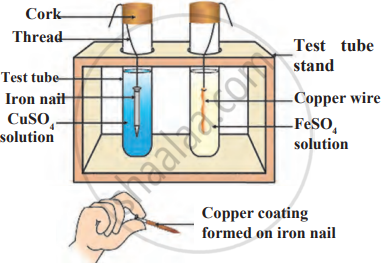
A metal A, which is used in thermite process, when heated with oxygen gives an oxide B, which is amphoteric in nature. Identify A and B. Write down the reactions of oxide B with HCl and NaOH.
A metal M does not liberate hydrogen from acids but reacts with oxygen to give a black colour product. Identify M and black coloured product and also explain the reaction of M with oxygen.
Give the steps involved in the extraction of metals of low and medium reactivity from their respective sulphide ores.
Of the three metals X, Y and Z. X reacts with cold water, Y with hot water and Z with steam only. Identify X, Y and Z and also arrange them in order of increasing reactivity.
An element A burns with golden flame in air. It reacts with another element B, atomic number 17 to give a product C. An aqueous solution of product C on electrolysis gives a compound D and liberates hydrogen. Identify A, B, C and D. Also write down the equations for the reactions involved.
