Advertisements
Advertisements
Question
A ball is rolling from A to D on a flat and smooth surface. Its speed is 2 cm/s. On reaching B, it was pushed continuously up to C. On reaching D from C, its speed had become 4 cm/s. It took 2 seconds for it to go from B to C. What is the acceleration of the ball as it goes from B to C?

Advertisements
Solution
The acceleration of the ball between A to B is zero as the speed and direction of the ball are constant. After point B, a force is applied. Thus, the ball will get accelerated.
`"Acceleration of the ball from B to C" = "Change in velocity from B to C"/"Time taken for this change"`
`"Acceleration of the ball from B to C" = (4 - 2)/2 = 1m"/"s^2`
RELATED QUESTIONS
State the type of motion represented by the following sketches in Figures.
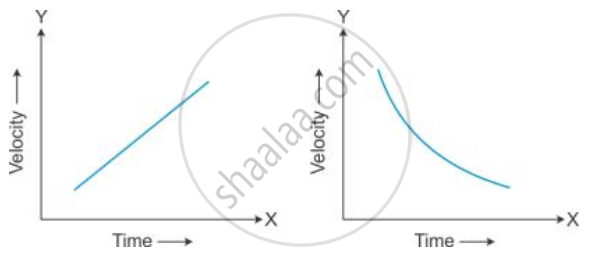
Give an example of each type of motion.
The velocity-time graph for a uniformly retarded body is a straight line inclined to the time axis with an obtuse angle. How is retardation calculated from the velocity-time graph?
From the diagram given below, calculate acceleration.
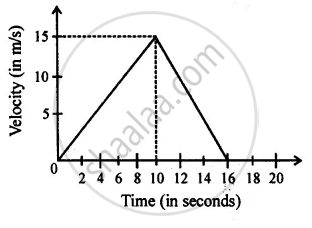
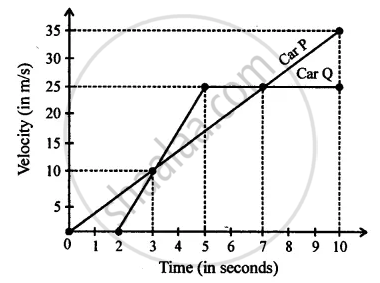
Diagram is given below shows velocity – time graph of car P and Q, starting from the same place and in the same direction. Calculate the Acceleration of car Q between 2 s – 5 s.
A truck running at 90 kmh−1, is brought to rest over a distance of 25 m. Calculate the retardation and time for which brakes are applied.
What is the SI unit of acceleration?
A body falls towards the earth. Does it have positive or negative acceleration?
Is it possible for an accelerating body to have constant speed?
The graph shows how the velocity of a scooter varies with time in 50 s.
Work out: Deceleration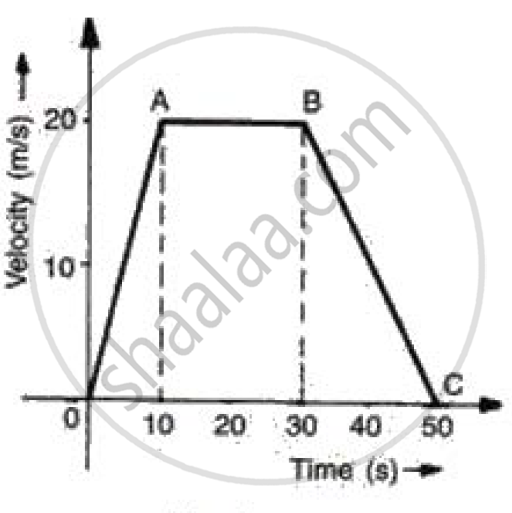
The Unit of acceleration is ______.
