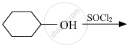
Draw the structure of major monohalo product in the following reaction: OH + SOCl2 ->
Advertisements
Question
Draw the structure of the major monohalo product in the following reaction:

Advertisements
Solution
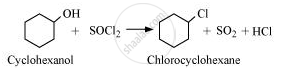
Chlorocyclohexane is the major monohalo product.
APPEARS IN
RELATED QUESTIONS
Draw the structure of the major monohalo product in the following reaction:

Draw the structures of major monohalo products in each of the following reaction:

Draw the structure of the major monohalo product in the following reaction:

Draw the structure of the major monohalo product in the following reaction:

Name the following halide according to the IUPAC system and classify it as an alkyl, allyl, benzyl (primary, secondary, tertiary), vinyl or aryl halide:
CH3CH2CH(CH3)CH(C2H5)Cl
Name the following halide according to the IUPAC system and classify it as an alkyl, allyl, benzyl (primary, secondary, tertiary), vinyl or aryl halide:
CH3C(C2H5)2CH2Br
Name the following halide according to the IUPAC system and classify it as an alkyl, allyl, benzyl (primary, secondary, tertiary), vinyl or aryl halide:
CH3C(Cl)(C2H5)CH2CH3
Draw the structure of major monohalo product in each of the following reactions :
When two halogen atoms are attached to the same carbon atom then it is:
In which of the following molecules carbon atom marked with asterisk (*) is asymmetric?
(a) \[\begin{array}{cc}
\ce{H}\\
|\\
\phantom{.}\ce{C^*}\phantom{}\\
\phantom{}/\phantom{..}|\phantom{..}\backslash\phantom{}\\
\phantom{.}\ce{I}\phantom{...}\ce{Br}\phantom{..}\ce{Cl}
\end{array}\]
(b) \[\begin{array}{cc}
\ce{D}\\
|\\
\phantom{.}\ce{C^*}\phantom{}\\
\phantom{}/\phantom{..}|\phantom{..}\backslash\phantom{}\\
\phantom{.}\ce{I}\phantom{...}\ce{Br}\phantom{..}\ce{Cl}
\end{array}\]
(c) \[\begin{array}{cc}
\ce{H}\\
|\\
\phantom{.}\ce{C^*}\phantom{}\\
\phantom{}/\phantom{..}|\phantom{..}\backslash\phantom{}\\
\phantom{..}\ce{OH}\phantom{..}\ce{C2H5}\phantom{}\ce{CH3}
\end{array}\]
(d) \[\begin{array}{cc}
\ce{H}\\
|\\
\phantom{.}\ce{C^*}\phantom{}\\
\phantom{}/\phantom{..}|\phantom{..}\backslash\phantom{}\\
\phantom{..}\ce{H}\phantom{...}\ce{C2H5}\phantom{}\ce{CH3}
\end{array}\]
The position of \[\ce{-Br}\] in the compound in \[\ce{CH3CH = CH(Br)(CH3)2}\] can be classified as ______.
Ethylidene chloride is a/an ______.
Which is the correct IUPAC name for \[\begin{array}{cc}
\ce{CH3 - CH - CH2 - Br}\\
\phantom{}|\phantom{.......}\\
\phantom{}\ce{C2H5}\phantom{....}
\end{array}\]?
What should be the correct IUPAC name for diethylbromomethane?
Which of the carbon atoms present in the molecule given below are asymmetric?
\[\begin{array}{cc}
\phantom{}\ce{HO}\phantom{.....}\ce{OH}\phantom{..}\ce{H}\phantom{.....}\ce{O}\phantom{..}\\
\phantom{..}\backslash\phantom{.....}|\phantom{....}|\phantom{.....}//\phantom{.}\\
\ce{\overset{a}{C} - \overset{b}{C} - \overset{c}{C} - \overset{d}{C}}\\
\phantom{..}//\phantom{.....}|\phantom{....}|\phantom{....}\phantom{.}\backslash\phantom{...}\\
\phantom{}\ce{O}\phantom{......}\ce{H}\phantom{...}\ce{OH}\phantom{...}\ce{H}\phantom{}\\
\end{array}\]
Haloalkanes contain halogen atom (s) attached to the sp3 hybridised carbon atom of an alkyl group. Identify haloalkane from the following compounds.
(i) 2-Bromopentane
(ii) Vinyl chloride (chloroethene)
(iii) 2-chloroacetophenone
(iv) Trichloromethane
IUPAC name of \[\begin{array}{cc}
\phantom{}\ce{CH3}\phantom{..........}\ce{Br}\phantom{........}\\
\phantom{}|\phantom{................}|\phantom{.........}\\
\phantom{}\ce{CH3CHCH2CHCHCH2CH3}\phantom{}\\
\phantom{}|\phantom{..}\\
\phantom{..}\ce{CH3}\phantom{}
\end{array}\] is ______.
