Advertisements
Advertisements
Question
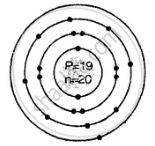
Draw the geometric atomic structure of the following atom showing the number of electrons, protons and neutrons in them:
\[\ce{^39_19K}\]
Advertisements
Solution
Geometric atomic structure of:
\[\ce{^39_19K}\]
Number of protons P = 19 = e
A = P + n
39 = 19 + n
∴ n = 39 − 19 = 20
e = 19 (2, 8, 8, 1)
Electronic configuration
2, 8, 8, 1 electronic arrangement
APPEARS IN
RELATED QUESTIONS
Give electron dot diagram of the following:
Magnesium chloride
(i) How many atoms of each kind are present in the following molecules: calcium oxide, chlorine, water, carbon tetrachloride?
(ii) How many electrons are required for their octet structure?
In term of electron transfer, define Oxidation
What type of bond is formed between two atoms, when the electronegative difference between them is low ?
Why do they exist as monoatoms in molecules?
Give the orbital diagram of the following:
Methane
Explain the following:
Carbon-12 and carbon-14 both show similar chemical properties.
In the formation of magnesium chloride (by direct combination between magnesium and chlorine), name the substance that is oxidized and the substance that is reduced.
Write the basic concept of Kossel – Lewis theory.
Elements A, B and C have atomic number 17, 19 and 10 respectively.
Write down the formula of the compound formed by two of the above elements.
