Advertisements
Advertisements
Question
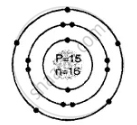
Draw the geometric atomic structure of the following atom showing the number of electrons, protons and neutrons in them:
\[\ce{^31_15P}\]
Advertisements
Solution
Geometric atomic structure of:
\[\ce{^31_15P}\]
Number of protons P = 15 = e number of electrons
A = P + n
31 = 15 + n
∴ n = 31 − 15 = 16 number of neutrons
Electronic configuration 2, 8, 5
In K shell = 2 electrons
In L shell = 8
In M shell = 5
APPEARS IN
RELATED QUESTIONS
Complete the following:
| Sodium | Phosphorus | Carbon | |
| Formula of chloride | |||
| Nature of bonding | |||
| Physical state of chloride |
How many atoms of each kind are present in the following molecules: calcium oxide, chlorine, water, carbon tetrachloride?
How many electrons are required by each atom mentioned in (a) to attain the nearest noble gas configuration?
State the following is a reduction reaction or oxidation reaction.
\[\ce{A^3+ + e- -> A^2+}\]
State one observation which shows that atom is not indivisible.
Why do they exist as monoatoms in molecules?
Draw the geometric atomic structure of the following atom showing the number of electrons, protons and neutrons in them:
\[\ce{^23_11Na}\]
Complete the table give below.
| Element |
Atomic number |
Electron distribution | Valence electrons | Lewis dot structure |
| Lithium | 3 | 1s22s1 | ||
| Boron | 5 | 1s22s22p1 | ||
| Oxygen | 8 | 1s22s22p4 |
Draw the electron distribution diagram for the formation of Carbon di oxide (CO2 ) molecule.
| Name of compound | Type of compound | |
| a. | Sodium chloride | ______ |
| b. | ______ | co-ordinate covalent compound |
| c. | Methane | ______ |
| d. | Fluorine molecule | ______ |
How many electrons are required or released by each atom in water molecule to attain the nearest noble gas configuration?
