Advertisements
Advertisements
प्रश्न
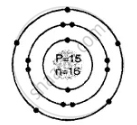
Draw the geometric atomic structure of the following atom showing the number of electrons, protons and neutrons in them:
\[\ce{^31_15P}\]
Advertisements
उत्तर
Geometric atomic structure of:
\[\ce{^31_15P}\]
Number of protons P = 15 = e number of electrons
A = P + n
31 = 15 + n
∴ n = 31 − 15 = 16 number of neutrons
Electronic configuration 2, 8, 5
In K shell = 2 electrons
In L shell = 8
In M shell = 5
APPEARS IN
संबंधित प्रश्न
Complete the following:
| Sodium | Phosphorus | Carbon | |
| Formula of chloride | |||
| Nature of bonding | |||
| Physical state of chloride |
What type of bond is formed between two atoms, when the electronegative difference between them is zero?
Explain fractional atomic mass. What is the fractional mass of chlorine?
How do atoms attain noble gas configurations?
Give the orbital diagram of the following:
Magnesium chloride
In the formation of magnesium chloride (by direct combination between magnesium and chlorine), name the substance that is oxidized and the substance that is reduced.
Five atoms are labelled V to Z
| Atoms | Mass Number | Atomic Number |
| V | 40 | 20 |
| W | 19 | 9 |
| X | 7 | 3 |
| Y | 16 | 8 |
| Z | 14 | 7 |
- Which one of these atoms
(1) contains 7 protons;
(2) has an electronic configuration 2, 7? - Write down the formula of the compound formed by atoms X and Y.
Draw the geometric atomic structure of the following atom showing the number of electrons, protons and neutrons in them:
\[\ce{^12_6C}\]
How do atoms attain Noble gas electronic configuration?
Why are Noble gases inert in nature?
