Advertisements
Advertisements
प्रश्न
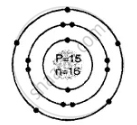
Draw the geometric atomic structure of the following atom showing the number of electrons, protons and neutrons in them:
\[\ce{^31_15P}\]
Advertisements
उत्तर
Geometric atomic structure of:
\[\ce{^31_15P}\]
Number of protons P = 15 = e number of electrons
A = P + n
31 = 15 + n
∴ n = 31 − 15 = 16 number of neutrons
Electronic configuration 2, 8, 5
In K shell = 2 electrons
In L shell = 8
In M shell = 5
APPEARS IN
संबंधित प्रश्न
State the type of bonding in the following molecule.
Calcium oxide
Element X is a metal with a valency 2; Y is a non-metal with a valency 3.
(a) Write an equation to show how Y forms as ion
(b) If Y is a diatomic gas, write an equation for the direct combination of X and Y to form a compound.
How are X-rays produced?
Compare :
Sodium atom and sodium ion
Potassium (at No.19) and chlorine (at No.17) react to form a compound. Explain the formation of the compound on the basis of oxidizing agent.
Element M forms a chloride with the formula MCl2 which is solid with a high melting point. What type of bond is in MCl2. Write the formula of the compound when M combines with sulphur, oxygen, and nitrogen.
Identify the following reaction as either oxidation or reduction:
O + 2e- → O2-
The element that would form cation due to the loss of electrons during the chemical reaction is ______.
The valency of noble gases is ______.
Choose the odd one out and write the reason:
