Advertisements
Advertisements
प्रश्न
Draw orbit structure diagram of sodium chloride (NaCl).
Advertisements
उत्तर
NaCl
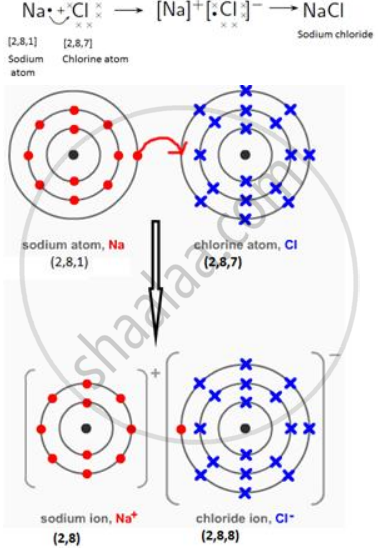
APPEARS IN
संबंधित प्रश्न
(i) How many atoms of each kind are present in the following molecules: calcium oxide, chlorine, water, carbon tetrachloride?
(ii) How many electrons are required for their octet structure?
Complete the following:
| Sodium | Phosphorus | Carbon | |
| Formula of chloride | |||
| Nature of bonding | |||
| Physical state of chloride |
Complete the statement by filling the gaps using appropriate term from the terms given in the bracket.
(slow, coloured, arrow, fast, smell, milky, physical, product, chemical, reactant, covalent, ionic, octet, duplet, exchange, sharing, equality sign)
Sodium chloride is ______ compound while hydrogen chloride is ______ compound.
The following table shows the electronic configuration of the elements W, X, Y, Z:
|
Element |
W |
X |
Y |
Z |
|
Electronic |
2,8,1 |
2,8,7 |
2,5 |
1 |
Answer the following questions based on the table above:
What is the formula of the compound formed between X and Z.
Choose the correct option
Which of the following is the correct electronic configuration of potassium?
Give the orbital diagram of the following:
Magnesium chloride
Element M forms a chloride with the formula MCl2 which is solid with a high melting point. What type of bond is in MCl2. Write the formula of the compound when M combines with sulphur, oxygen, and nitrogen.
Number of valence electrons in carbon is ______.
Draw the electron distribution diagram for the formation of Carbon di oxide (CO2 ) molecule.
How many electrons are required or released by each atom in water molecule to attain the nearest noble gas configuration?
