Advertisements
Advertisements
Question
Derive the expression for resultant capacitance, when the capacitor is connected in parallel.
Advertisements
Solution
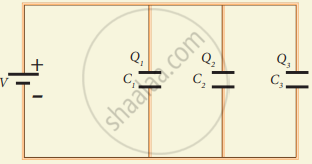
Consider three capacitors of capacitance C1,C2 and C3 connected in parallel with a battery of voltage V as shown in figure (a).
(a) capacitors in parallel-
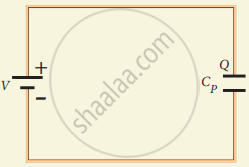
(b) equivalent capacitance with the same total charge
Since corresponding sides of the capacitors are connected to the same positive and negative terminals of the battery, the voltage across each capacitor is equal to the battery’s voltage. Since capacitance of the capacitors is different, the charge stored in each capacitor is not the same. Let the charge stored in the three capacitors be Q1,Q2, and Q2 respectively. According to the law of conservation of total charge, the sum of these three charges is equal to the charge Q transferred by the battery,
Q = Q1 + Q2 + Q3 ….. (1)
Now, since Q = CV, we have
Q = C1V + C2 V + C3 V ….. (2)
If these three capacitors are considered to form a single capacitance CP which stores the total charge Q as shown in figure (b), then we can write Q = CPV. Substituting this in equation (2), we get
Cp V = C1 V + C2 V + C3 V
Cp = C1 + C2 + C3
Thus, the equivalent capacitance of capacitors connected in parallel is equal to the sum of the individual capacitance. The equivalent capacitance Cp in a parallel connection is always greater than the largest individual capacitance. In a parallel connection, it is equivalent as area of each capacitance adds to give more effective area such that total capacitance increases.
APPEARS IN
RELATED QUESTIONS
(i) Find equivalent capacitance between A and B in the combination given below. Each capacitor is of 2 µF capacitance.
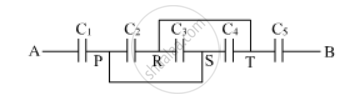
(ii) If a dc source of 7 V is connected across AB, how much charge is drawn from the source and what is the energy stored in the network?
A capacitor has capacitance C. Is this information sufficient to know what maximum charge the capacitor can contain? If yes, what is this charges? If no, what other information is needed?
Three capacitors of capacitances 6 µF each are available. The minimum and maximum capacitances, which may be obtained are
Convince yourself that parts (a), (b) and (c) figure are identical. Find the capacitance between the points A and B of the assembly.
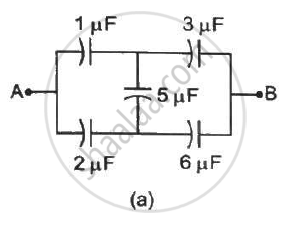
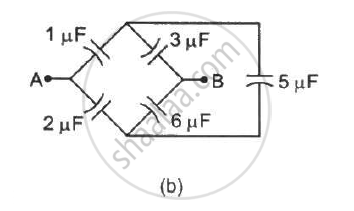
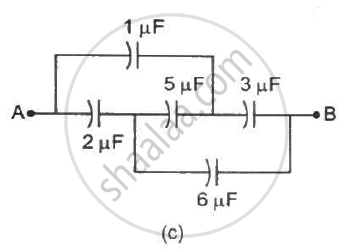
Find the capacitance of the combination shown in figure between A and B.
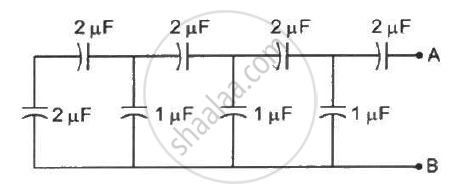
A capacitor of capacitance 10 μF is connected to a battery of emf 2 V. It is found that it takes 50 ms for the charge of the capacitor to become 12.6 μC. Find the resistance of the circuit.
The separation between the plates of a parallel-plate capacitor is 0⋅500 cm and its plate area is 100 cm2. A 0⋅400 cm thick metal plate is inserted into the gap with its faces parallel to the plates. Show that the capacitance of the assembly is independent of the position of the metal plate within the gap and find its value.
You are provided with 8 μF capacitors. Show with the help of a diagram how you will arrange minimum number of them to get a resultant capacitance of 20 μF.
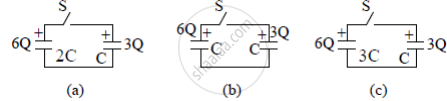
Three circuits, each consisting of a switch 'S' and two capacitors, are initially charged, as shown in the figure. After the switch has been closed, in which circuit will the charge on the left-hand capacitor
(i) increase,
(ii) decrease, and
(iii) remains the same? Give reasons.
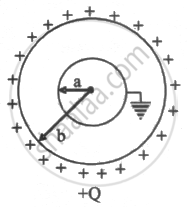
Two spherical conductors A and B of radii a and b(b > a) are placed concentrically in the air. B is given a charge +Q and A is earthed. The equivalent capacitance of the system is ______.