English

Cos 2 X D Y D X + Y = Tan X - Mathematics

Advertisements
Advertisements

Question

\[\cos^2 x\frac{dy}{dx} + y = \tan x\]

Sum
Advertisements

Solution

We have,

\[ \cos^2 x\frac{dy}{dx} + y = \tan x\]

\[ \Rightarrow \frac{dy}{dx} + \left( \sec^2 x \right)y = \left( \tan x \right) \sec^2 x\]

\[\text{Comparing with }\frac{dy}{dx} + Px = Q,\text{ we get}\]

\[P = \sec^2 x \]

\[Q = \left( \tan x \right)\left( \sec^2 x \right)\]

Now,

\[I . F . = e^{\int \sec^2 x dx} = e^{\tan x} \]

So, the solution is given by

\[y \times e^{\tan x} = \int\left( \tan x \right)\left( \sec^2 x \right) \times e^{\tan x} dx + C\]

\[ \Rightarrow y e^{\tan x} = I + C . . . . . . . . . . \left( 1 \right)\]

Now,

\[I = \int\left( \tan x \right)\left( \sec^2 x \right) \times e^{\tan x} dx\]

Putting `t = tan x,` we get

\[dt = \sec^2 x dx\]
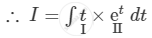
\[ = t \times \int e^t dt - \int\left( \frac{d t}{d t} \times \int e^t dt \right)dt\]

\[ = t e^t - \int e^t dt\]

\[ = t e^t - e^t \]

\[ \Rightarrow I = \tan x e^{\tan x} - e^{\tan x} = e^{\tan x} \left( \tan x - 1 \right)\]

Putting the value of `I` in (1), we get

\[y e^{\tan x} = e^{\tan x} \left( \tan x - 1 \right) + C\]

shaalaa.com
  Is there an error in this question or solution?
Chapter 22: Differential Equations - Revision Exercise [Page 146]

APPEARS IN

RD Sharma Mathematics [English] Class 12
Chapter 22 Differential Equations
Revision Exercise | Q 55 | Page 146

RELATED QUESTIONS

Solve : 3ex tanydx + (1 +ex) sec2 ydy = 0

Also, find the particular solution when x = 0 and y = π.


Find the particular solution of the differential equation `(1+x^2)dy/dx=(e^(mtan^-1 x)-y)` , give that y=1 when x=0.


If y = P eax + Q ebx, show that

`(d^y)/(dx^2)=(a+b)dy/dx+aby=0`


Find the particular solution of the differential equation log(dy/dx)= 3x + 4y, given that y = 0 when x = 0.


Verify that the given function (explicit or implicit) is a solution of the corresponding differential equation:

y = Ax : xy′ = y (x ≠ 0)


The number of arbitrary constants in the particular solution of a differential equation of third order are ______.


Find the differential equation of the family of concentric circles `x^2 + y^2 = a^2`


The general solution of the differential equation \[\frac{dy}{dx} = \frac{y}{x}\] is


Solution of the differential equation \[\frac{dy}{dx} + \frac{y}{x}=\sin x\] is


The solution of the differential equation \[\frac{dy}{dx} + 1 = e^{x + y}\], is


The solution of the differential equation \[\frac{dy}{dx} - ky = 0, y\left( 0 \right) = 1\] approaches to zero when x → ∞, if


The number of arbitrary constants in the particular solution of a differential equation of third order is


The general solution of a differential equation of the type \[\frac{dx}{dy} + P_1 x = Q_1\] is


Find the general solution of the differential equation \[x \cos \left( \frac{y}{x} \right)\frac{dy}{dx} = y \cos\left( \frac{y}{x} \right) + x .\]


Write the solution of the differential equation \[\frac{dy}{dx} = 2^{- y}\] .


cos (x + y) dy = dx


\[\frac{dy}{dx} + \frac{y}{x} = \frac{y^2}{x^2}\]


(x + y − 1) dy = (x + y) dx


\[\frac{dy}{dx} - y \cot x = cosec\ x\]


`(2ax+x^2)(dy)/(dx)=a^2+2ax`


\[y - x\frac{dy}{dx} = b\left( 1 + x^2 \frac{dy}{dx} \right)\]


\[\left( 1 + y^2 \right) + \left( x - e^{- \tan^{- 1} y} \right)\frac{dy}{dx} = 0\]


Solve the following differential equation:- \[\left( x - y \right)\frac{dy}{dx} = x + 2y\]


Solve the following differential equation:-

\[\frac{dy}{dx} - y = \cos x\]


Solve the following differential equation:-

\[\left( x + y \right)\frac{dy}{dx} = 1\]


The general solution of the differential equation `"dy"/"dx" = "e"^(x - y)` is ______.


The general solution of the differential equation `"dy"/"dx" + y/x` = 1 is ______.


y = x is a particular solution of the differential equation `("d"^2y)/("d"x^2) - x^2 "dy"/"dx" + xy` = x.


Solve: `y + "d"/("d"x) (xy) = x(sinx + logx)`


If y = e–x (Acosx + Bsinx), then y is a solution of ______.


Solution of differential equation xdy – ydx = 0 represents : ______.


y = aemx+ be–mx satisfies which of the following differential equation?


General solution of `("d"y)/("d"x) + y` = sinx is ______.


The member of arbitrary constants in the particulars solution of a differential equation of third order as


Find the general solution of the differential equation `x (dy)/(dx) = y(logy - logx + 1)`.


Find the general solution of the differential equation:

`(dy)/(dx) = (3e^(2x) + 3e^(4x))/(e^x + e^-x)`


The differential equation of all parabolas that have origin as vertex and y-axis as axis of symmetry is ______.


Share
Notifications

Englishहिंदीमराठी


      Forgot password?
Use app×