Advertisements
Advertisements
Question
Write the mechanism of the following reaction:
\[\ce{{n}BuBr + KCN ->[EtOH-H2O] {n}BuCN}\]
Advertisements
Solution 1
This reaction is a first-order nucleophilic substitution (SN1). The mechanism can be stated as:
Step 1: Generation of nucleophile:
\[\ce{KCN ->[EtOH-H2O]K+ + \overset{—}{C} ≡ N}\]
Step 2: Nucleophilic attack and formation of transition state:
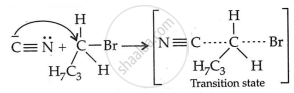
Step 3: Generation of product:
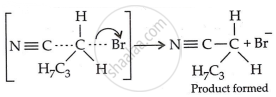
Therefore, we have
\[\ce{CH3 - CH2 - CH2 - CH2 - Br + KCN ->[EtOH/H2O]CH3CH2CH2CH2CN + KBr}\]
Solution 2
KCN is the resonating hybrid of the following structures:
\[\ce{K^+ [^- :C ≡ N: ↔ :C = \overset{\bullet\bullet}{N} :^-]}\]
Therefore, CN⁻ acts as an ambident nucleophile. It can attack the carbon atom of the C-Br bond in n-BuBr through either the carbon (C) or nitrogen (N) atom. Since the C-N bond is weaker than the C-C bond, the attack occurs at the carbon atom, leading to the formation of n-butyl cyanide.
\[\ce{K^+CN^- + \underset{n-butyl bromide}{CH3CH2CH2\overset{δ+}{C}H2 - \overset{δ-}{B}r} -> \underset{n-butyl cyanide}{CH3CH2CH2CH2CN} + KBr}\]
Notes
Students can refer to the provided solutions based on their preferred marks.
APPEARS IN
RELATED QUESTIONS
Given reasons: C–Cl bond length in chlorobenzene is shorter than C–Cl bond length in CH3–Cl.
Arrange the compounds of the following set in order of reactivity towards SN2 displacement:
2-Bromo-2-methylbutane, 1-Bromopentane, 2-Bromopentane
What happens when chlorobenzene is subjected to hydrolysis?
AgCN reacts with haloalkanes to form isocyanide. Haloalkanes react with KCN to form alkyl cyanides as the main product. Why?
Which of the following is a primary halide?
Halogenation of alkanes is ____________.
Most reactive halide towards SN1 reaction is ____________.
Which among MeX, RCH2X, R2CHX and R3CX is most reactive towards SN2 reaction?
Which of the following is an optically active compound?
Which of the following compounds is optically active?
Identify X and Y in the following sequence:
\[\ce{C2H5Br ->[X] Product ->[Y] C3H7NH2}\]
Assertion: KCN reacts with methyl chloride to give methyl isocyanide.
Reason: CN– is an ambident nucleophile.
A primary alkyl halide would prefer to undergo ______.

Which of the statements are correct about above reaction?
(i) (a) and (e) both are nucleophiles.
(ii) In (c) carbon atom is sp3 hybridised.
(iii) In (c) carbon atom is sp2 hybridised.
(iv) (a) and (e) both are electrophiles.
Which of the compounds will react faster in SN1 reaction with the –OH ion?
\[\ce{CH3-CH2-Cl}\] or \[\ce{C6H5-CH2-Cl}\]
Why are aryl halides less reactive towards nucleophilic substitution reactions than alkyl halides?
Retention of configuration is observed in ______.
The following questions are case-based questions. Read the passage carefully and answer the questions that follow:
|
Nucleophilic Substitution: Influences of solvent polarity: The reaction rate (SN2) of 2-bromopropane and NaOH in ethanol containing 40% water is twice slower than in absolute ethanol. Hence the level of solvent polarity has an influence on both SN1 and SN2 reactions but with different results. Generally speaking, a weak polar solvent is favourable for SN2 reaction, while a strong polar solvent is favourable for SN1. Generally speaking, the substitution reaction of tertiary haloalkane is based on SN1 mechanism in solvents with a strong polarity (for example ethanol containing water). |
Answer the following questions:
(a) Why racemisation occurs in SN1? (1)
(b) Why is ethanol less polar than water? (1)
(c) Which one of, the following in each pair is more reactive towards SN2 reaction? (2)
(i) CH3 – CH2 – I or CH3CH2 – Cl
(ii)
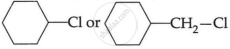
OR
(c) Arrange the following in the increasing order of their reactivity towards SN1 reactions: (2)
(i) 2-Bromo-2-methylbutane, 1-Bromo-pentane, 2-Bromo-pentane
(ii) 1-Bromo-3-methylbutane, 2-Bromo-2-methylbutane, 2-Bromo-3- methylbutane
An organic compound A with the molecular formula (+) C4H9Br undergoes hydrolysis to form (+) C4H9OH. Give the structure of A and write the mechanism of the reaction.
Discuss SN2 mechanism of methyl bromide using aqueous KOH.
