Advertisements
Advertisements
Question
An ether (A), C5H12O, when heated with excess of hot HI produce two alkyl halides which on hydrolysis form compound (B) and (C), oxidation of (B) gave and acid (D), whereas oxidation of (C) gave a ketone (E). Deduce the structural formula of (A), (B), (C), (D), and (E).
Advertisements
Solution
i. The ether (A) with molecular formula C5H12O is
\[\begin{array}{cc}
\ce{H3C - CH2 - O - HC -CH3}\\
\phantom{..............}|\\
\phantom{................}\ce{CH3}\\
\end{array}\]
ii. Reacts with hot HI to produce two alkyl halides as follows:

iii. Oxidation of (B) gives acid
\[\ce{CH3 - CH2 - OH ->[{[O]}] \underset{(D)}{CH3COOH}}\]
iv. Oxidation of (C) gives ketone
\[\begin{array}{cc}
\ce{CH3 - CH - OH ->[{[O]}] CH3 - C = O}\\
\phantom{...}|\phantom{....................}|\\
\phantom{....}\ce{CH3}\phantom{...........}\ce{(E)}\phantom{...}\ce{CH3}\\
\end{array}\]
Hence, structural formulae of compounds (A) to (E) are
(A) (2-Ethoxypropane)
\[\begin{array}{cc}
\ce{CH3 - CH2 - O - CH - CH3}\\
\phantom{.....................}|\phantom{...........}\\ \phantom{.......................}\ce{CH3\phantom{...........}}\\
\end{array}\]
(B) (Ethanol)
CH3CH2–OH
(c) (Propan-2-ol)
\[\begin{array}{cc}
\ce{CH3 - CH - CH3}\\
\phantom{..}|\\
\phantom{....}\ce{OH}\\
\end{array}\]
(D) (Ethanoic acid)
CH3COOH
(E) (Propanone)
\[\begin{array}{cc}
\ce{CH3 - C = O}\\
\phantom{...}|\phantom{.}\\
\phantom{....}\ce{CH3}\\
\end{array}\]
APPEARS IN
RELATED QUESTIONS
Write two points of difference between the properties of phenol and ethyl alcohol.
Give the reagents and conditions necessary to prepare phenol from Chlorobenzene.
Answer in brief.
Give a simple chemical test to distinguish between ethanol and ethyl bromide.
The reagents used to convert phenol to 2,4,6-tribromophenol is _____________
What is the action of following on phenol at low temperature?
- dil. HNO3
- conc. H2SO4
- Br2/CS2
Write chemical reactions to convert phenol into salicyaldehyde. Write the name of the reaction. What happens when if CCl4 is used instead of CHCl3 in the above reaction.
Number of oxygen atoms present in salicylaldehyde are ______.
\[\ce{C3H8O ->[KMnO4][(Oxidation)] C3H6O2}\]
The compound C3H8O is a/an ____________.
Which of the following compounds is obtained, when phenol react with bromine water?
The product 'C' in the following reaction is:
\[\ce{CH3CH2Br ->[alc. KCN] {'A'} ->[H3O^+][\Delta] {'B'} ->[i. LiAlH4][ii. H3O^+] {'C'}}\]
+I effect of alkyl groups in alcohols increases the stability of ____________.
____________ will NOT undergo acetylation.
Phenoxide ion is more stable than phenol due to the ____________.
\[\ce{Isopropyl alcohol + acidic K2Cr2O7 -> X}\]
Identify product 'X' in the above reactions.
Identify the reagent A used in the following conversion.
\[\ce{Phenol ->[A] Benzoquinone}\]
Identify the alcohol that reacts immediately with Lucas reagent?
Identify the role of PDC from the following.
Identify the product X in the following reaction.
\[\ce{Phenol ->[Na2Cr2O7][H2SO4] X}\]
The compound which reacts fastest with Lucas reagent at room temperature is ______.
Identify the compound amongst the following of which 0.1 M aqueous solution has highest boiling point.
Amongst the following alcohols which would react fastest with cone. HCl and ZnCl2?
Which among the following is not the method of preparation of phenol?
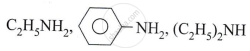
Arrange the following compounds in an increasing order of their solubility in water:
Write the product when 1°, 2° and 3° alcohol vapours are passed over hot copper.
Explain: Phenols are acid while alcohol is neutral.
What is the commercial method of preparation of phenol?
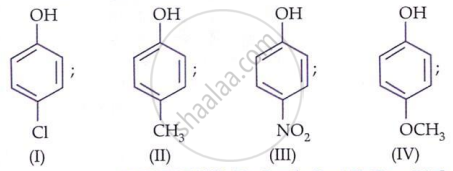
Arrange the following compounds in order of decreasing acidity:
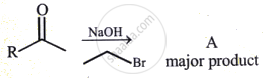
The structure of A in the given reaction is:
Which of the following is primary benzylic alcohol?
