Advertisements
Advertisements
Question
A uniform metre rule rests horizontally on a knife-edge at the 60 cm mark when a mass of 10 gram is suspended from one end. At which end must this mass be suspended? What is the mass of the rule?
Advertisements
Solution
Let M gram be the mass of the rule. Since the density of the rule is uniform, its weight Mg will act at its middle point i.e., at the 50 cm mark (Fig.).

The weight of the rule produces an anti-clockwise moment about the knife-edge O. In order to balance it, 10-gram mass is to be suspended at the end B, to produce a clockwise moment.
From the principle of moments,
Anti-clockwise moment = Clockwise moment
Mg × (60 – 50) = 10 g × (100-60)
or Mg × 10 = 10 g × 40
∴ M = 40 gram
RELATED QUESTIONS
Thrust is the ............ force acting on a surface.
State two effects of a force when applied on a body.
How does the effect of force differ when it is applied on a rigid body?
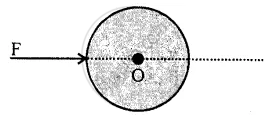
In Fig. a force F is applied in a direction passing through the pivoted point O of the body. Will the body rotate? Give reason to support your answer.
What do you understand by the clockwise and anticlockwise moment of force? When is it taken positive?
A body is acted upon by two forces of magnitude F but in opposite directions. State the effect of the force if both forces act at the same point of the body.
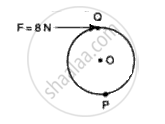
A wheel of diameter 3 m is shown in fig. 2 with axle at 0. A force F = 8 N is applied at Q in the direction shown in figure. Calculate the moment of force about:
(i) centre o, and
(ii) point p.
State the effects that a force can produce. Given one example of each.
Clockwise moment produced by a force about a fulcrum is considered to be ______.
