Advertisements
Advertisements
प्रश्न
A uniform metre rule rests horizontally on a knife-edge at the 60 cm mark when a mass of 10 gram is suspended from one end. At which end must this mass be suspended? What is the mass of the rule?
Advertisements
उत्तर
Let M gram be the mass of the rule. Since the density of the rule is uniform, its weight Mg will act at its middle point i.e., at the 50 cm mark (Fig.).

The weight of the rule produces an anti-clockwise moment about the knife-edge O. In order to balance it, 10-gram mass is to be suspended at the end B, to produce a clockwise moment.
From the principle of moments,
Anti-clockwise moment = Clockwise moment
Mg × (60 – 50) = 10 g × (100-60)
or Mg × 10 = 10 g × 40
∴ M = 40 gram
संबंधित प्रश्न
A force always produces both the linear and turning motions.
A potter turns his wheel by applying a force through the stick near the rim of wheel.
Sleepers are used below the rails.
State the relationship between force, mass and acceleration. Draw graphs showing the relationship between Acceleration and force for a constant mass.
The stone of hand flour grinder is provided with a handle near its rim. Give reason.
Three forces A, B and C are acting on a rigid body which can turn about O in fig.9. If all the three forces are applied simultaneously, in which direction will the body move? Explain.
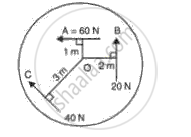
State two factors on which moment of the force about a point depends.
The perpendicular distance between the point of application of force and turning point is 1.75 m when a force of 80 N acts on a rigid body. Calculate the moment of force.
Calculate the length of arm of couple, if a force of 13 N produces a moment of couple of 14.3 Nm.
