Advertisements
Advertisements
Question
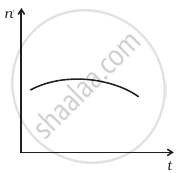
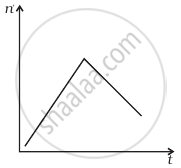
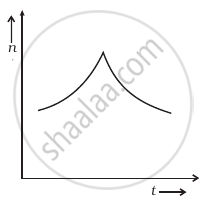
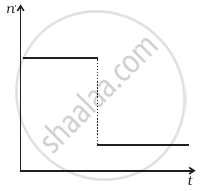
A train whistling at constant frequency is moving towards a station at a constant speed V. The train goes past a stationary observer on the station. The frequency n ′ of the sound as heard by the observer is plotted as a function of time t (figure). Identify the expected curve.
Options
Advertisements
Solution
Explanation:
Let the original frequency of the source is n0.
Let the speed of sound wave n the medium be v.
As the observer is stationary

Apparent frequency `n_a = (v/(v - v_s)) n_o` ......[When the train is approaching]
= `(v/(v - v_s)) n_o`
= `n_a > n_o`
When the train is going away from the observer
Apparent frequency `n_a = (v/(v +v_s)) n_0`
= `n_a < n_o`
APPEARS IN
RELATED QUESTIONS
A narrow sound pulse (for example, a short pip by a whistle) is sent across a medium. (a) Does the pulse have a definite (i) frequency, (ii) wavelength, (iii) speed of propagation? (b) If the pulse rate is 1 after every 20 s, (that is the whistle is blown for a split of second after every 20 s), is the frequency of the note produced by the whistle equal to 1/20 or 0.05 Hz
The change in frequency due to Doppler effect does not depend on
Solve the following problem.
A police car travels towards a stationary observer at a speed of 15 m/s. The siren on the car emits a sound of frequency 250 Hz. Calculate the recorded frequency. The speed of sound is 340 m/s.
The sound emitted from the siren of an ambulance has a frequency of 1500 Hz. The speed of sound is 340 m/s. Calculate the difference in frequencies heard by a stationary observer if the ambulance initially travels towards and then away from the observer at a speed of 30 m/s.
Explain red shift and blue shift in Doppler Effect.
Discuss the following case-
Observer in motion and Source at rest.
- Observer moves towards Source
- Observer resides away from the Source
Consider a mixture of 2 mol of helium and 4 mol of oxygen. Compute the speed of sound in this gas mixture at 300 K.
Two cars moving in opposite directions approach each other with speed of 22 m/s and 16.5 m/s respectively. The driver of the first car blows a horn having a frequency 400 Hz. The frequency heard by the driver of the second car is [velocity of sound 340 m/s]: ____________.
A railway engine whistling at a constant frequency moves with a constant speed aixi it goes past a stationary observer standing beside the railway track. Then the frequency of (n') of the sound heard by the observer with respect to time (t) can be best represented by which of the following curve?
An observer moves towards a stationary source of sound with a velocity one-fifth of the velocity of sound. The percentage increase in the apparent frequency heard by the observer will be ______.
A source of sound is moving towards a stationary observer with velocity 'Vs' and then moves away with velocity 'Vs'. Assume that the medium through which the sound waves travel is at rest, if 'V' is the velocity of sound and 'n' is the frequency emitted by the source, then the difference between the apparent frequencies heard by the observer is ______.
With what velocity an observer should move relative to a stationary source so that a sound of double the frequency of source is heard by an observer?
In a quink tube experiment, a tuning fork of frequency 300 Hz is vibrated at one end. It is observed that intensity decreases from maximum to 50% of its maximum value, as tube is moved by 6.25 cm. Velocity of sound is ______ m/s.
When a sound source of frequency n is approaching a stationary observer with velocity u than the apparent change in frequency is Δn1 and when the same source is receding with velocity u from the stationary observer than the apparent change in frequency is Δn2. Then ______.
When an engine passes near to a stationary observer then its apparent frequencies occurs in the ratio 5/3. If the velocity of engine is ______.
A racing car moving towards a cliff sounds its horn. The sound reflected from the cliff has a pitch one octave higher than the actual sound of the horn. If V is the velocity of sound, the velocity of the car is ______.
The frequency of echo will be ______ Hz if the train blowing a whistle of frequency 320 Hz is moving with a velocity of 36 km/h towards a hill from which an echo is heard by the train driver. The velocity of sound in air is 330 m/s.
A whistle producing sound waves of frequencies 9500 Hz and above is approaching a stationary person with speed v ms-1. The velocity of sound in air is 300 ms-1. If the person can hear frequencies up to a maximum of 10,000 HZ, the maximum value of v up to which he can hear the whistle is ______.
