Advertisements
Advertisements
प्रश्न
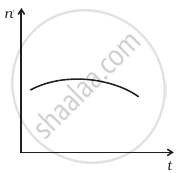
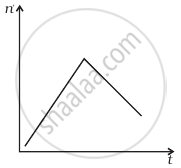
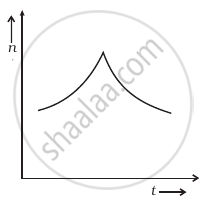
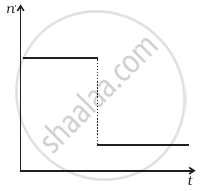
A train whistling at constant frequency is moving towards a station at a constant speed V. The train goes past a stationary observer on the station. The frequency n ′ of the sound as heard by the observer is plotted as a function of time t (figure). Identify the expected curve.
विकल्प
Advertisements
उत्तर
Explanation:
Let the original frequency of the source is n0.
Let the speed of sound wave n the medium be v.
As the observer is stationary

Apparent frequency `n_a = (v/(v - v_s)) n_o` ......[When the train is approaching]
= `(v/(v - v_s)) n_o`
= `n_a > n_o`
When the train is going away from the observer
Apparent frequency `n_a = (v/(v +v_s)) n_0`
= `n_a < n_o`
APPEARS IN
संबंधित प्रश्न
The change in frequency due to Doppler effect does not depend on
Answer briefly.
State the expression for apparent frequency when the source is stationary and the listener is
- moving towards the source
- moving away from the source
Solve the following problem.
A police car travels towards a stationary observer at a speed of 15 m/s. The siren on the car emits a sound of frequency 250 Hz. Calculate the recorded frequency. The speed of sound is 340 m/s.
What is meant by the Doppler effect?
Discuss the following case-
Observer in motion and Source at rest.
- Observer moves towards Source
- Observer resides away from the Source
The speed of a wave in a certain medium is 900 m/s. If 3000 waves passes over a certain point of the medium in 2 minutes, then compute its wavelength?
A ship in a sea sends SONAR waves straight down into the seawater from the bottom of the ship. The signal reflects from the deep bottom bedrock and returns to the ship after 3.5 s. After the ship moves to 100 km it sends another signal which returns back after 2 s. Calculate the depth of the sea in each case and also compute the difference in height between two cases.
Two cars moving in opposite directions approach each other with speed of 22 m/s and 16.5 m/s respectively. The driver of the first car blows a horn having a frequency 400 Hz. The frequency heard by the driver of the second car is [velocity of sound 340 m/s]: ____________.
A source of sound is moving with constant velocity of 30 mis emitting a note of frequency 256 Hz. The ratio of frequencies observed by a stationary observer while the source is approaching him and after it crosses him is ______. (speed of sound in air = 330 m/s)
A bus is moving with a velocity of 5 m is towards a wall. The driver blows the horn of frequency 165 Hz. If the speed of sound in air is 335 m is, then after reflection of sound wave, the number of beats per second heard by the passengers in the bus will be ______.
The pitch of the whistle of an engine appears to drop to`(5/6)^"th"` of original value when it passes a stationary observer. If the speed of sound in air is 350 m/s then the speed of engine is ____________.
If a star appearing yellow starts accelerating towards the earth, its colour appears to be turned ______.
A car sounding a horn of frequency 1000 Hz passes au observer. The ratio of frequencies of the horn noted by the observer before and after passing of the car is 11 : 9. If the speed of sound is 'V', the speed of the car is ______.
A source and a detector move away from each other in absence of wind with a speed of 20 m/s with respect to the ground. If the detector detects a frequency of 1800 Hz of the sound coming from the source, then the original frequency of the source considering the speed of sound in air 340 m/s will be ______ Hz.
When a sound source of frequency n is approaching a stationary observer with velocity u than the apparent change in frequency is Δn1 and when the same source is receding with velocity u from the stationary observer than the apparent change in frequency is Δn2. Then ______.
A whistle producing sound waves of frequencies 9500 Hz and above is approaching a stationary person with speed v ms-1. The velocity of sound in air is 300 ms-1. If the person can hear frequencies up to a maximum of 10,000 HZ, the maximum value of v up to which he can hear the whistle is ______.
The observer is moving with velocity 'v0' towards the stationary source of sound and then after crossing moves away from the source with velocity 'v0'. Assume that the medium through which the sound waves travel is at rest. If v is the velocity of sound and n is the frequency emitted by the source, then the difference between apparent frequencies heard by the observer is ______.
The pitch of the whistle of an engine appears to drop by 20% of its original value when it passes a stationary observer. If the speed of sound in the air is 350 m/s, then the speed of the engine (in m/s) is ______.
