Advertisements
Advertisements
प्रश्न
Discuss the following case-
Observer in motion and Source at rest.
- Observer moves towards Source
- Observer resides away from the Source
Advertisements
उत्तर
(a) Observer moves towards Source:
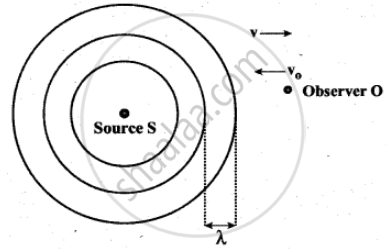
Observer moves towards Source
We can assume that the observer O moves towards the source S with velocity vo. The source S is at rest and the velocity of sound waves (with respect to the medium) produced by the source is v.
From the Figure, It is observed that both vo and v are in opposite direction. Then, their relative velocity is vr = v + vo. The wavelength of the sound wave is λ = `"v"/"f"`, which means the frequency observed by the observer O is f ‘ = `"v"_"r"/lambda`. Then
`"f"' = "v"_"r"/lambda = (("v" + "v"_0)/"v")"f"`
`= "f"(1 + "v"_0/"v")` ...(7)
(b) Observer recedes away from the Source:
If the observer O is moving away (receding away) from the source S, then velocity v0 and v move in the same direction. Hence, their relative velocity is vr = v – v0. Hence, the frequency observed by the observer O is
`"f"' = "v"_"r"/lambda = (("v" + "v"_0)/"v")"f"`
`= "f"(1 - "v"_0/"v")` ...(8)
APPEARS IN
संबंधित प्रश्न
The engine of a train sounds a whistle at frequency v. The frequency heard by a passenger is
The change in frequency due to Doppler effect does not depend on
The sound emitted from the siren of an ambulance has a frequency of 1500 Hz. The speed of sound is 340 m/s. Calculate the difference in frequencies heard by a stationary observer if the ambulance initially travels towards and then away from the observer at a speed of 30 m/s.
What is meant by the Doppler effect?
Discuss the following case:
Source in motion and Observer at rest
- Source moves towards observer
- Source moves away from the observer
N tuning forks are arranged in order of increasing frequency and any two successive tuning forks give n beats per second when sounded together. If the last fork gives double the frequency of the first (called as octave), Show that the frequency of the first tuning fork is f = (N – 1)n.
The difference between the apparent frequency of a source of sound as perceived by the observer during its approach and recession is 2% of the frequency of the source. If the speed of sound in air is 300 ms-1, then the velocity of the source is ______.
The pitch of the whistle of an engine appears to drop to`(5/6)^"th"` of original value when it passes a stationary observer. If the speed of sound in air is 350 m/s then the speed of engine is ____________.
A train whistling at constant frequency is moving towards a station at a constant speed V. The train goes past a stationary observer on the station. The frequency n ′ of the sound as heard by the observer is plotted as a function of time t (figure). Identify the expected curve.
The period of rotation of the sun at its equator is T and its radius is R. Then the Doppler wavelength shift expected for light with wavelength λ emitted from the edge of the sun's disc is: [c = speed of light]
