Advertisements
Advertisements
प्रश्न
Discuss the following case-
Observer in motion and Source at rest.
- Observer moves towards Source
- Observer resides away from the Source
Advertisements
उत्तर
(a) Observer moves towards Source:
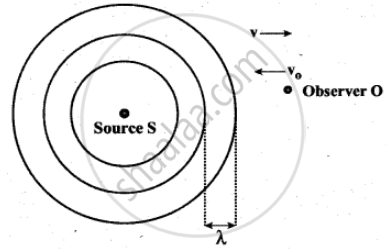
Observer moves towards Source
We can assume that the observer O moves towards the source S with velocity vo. The source S is at rest and the velocity of sound waves (with respect to the medium) produced by the source is v.
From the Figure, It is observed that both vo and v are in opposite direction. Then, their relative velocity is vr = v + vo. The wavelength of the sound wave is λ = `"v"/"f"`, which means the frequency observed by the observer O is f ‘ = `"v"_"r"/lambda`. Then
`"f"' = "v"_"r"/lambda = (("v" + "v"_0)/"v")"f"`
`= "f"(1 + "v"_0/"v")` ...(7)
(b) Observer recedes away from the Source:
If the observer O is moving away (receding away) from the source S, then velocity v0 and v move in the same direction. Hence, their relative velocity is vr = v – v0. Hence, the frequency observed by the observer O is
`"f"' = "v"_"r"/lambda = (("v" + "v"_0)/"v")"f"`
`= "f"(1 - "v"_0/"v")` ...(8)
APPEARS IN
संबंधित प्रश्न
State the expression for apparent frequency when listener is stationary and source is moving towards the listener.
Solve the following problem.
A police car travels towards a stationary observer at a speed of 15 m/s. The siren on the car emits a sound of frequency 250 Hz. Calculate the recorded frequency. The speed of sound is 340 m/s.
Discuss the following case:
Source in motion and Observer at rest
- Source moves towards observer
- Source moves away from the observer
A bus is moving with a velocity of 5 m is towards a wall. The driver blows the horn of frequency 165 Hz. If the speed of sound in air is 335 m is, then after reflection of sound wave, the number of beats per second heard by the passengers in the bus will be ______.
If a star appearing yellow starts accelerating towards the earth, its colour appears to be turned ______.
A source of sound is moving towards a stationary observer with velocity 'Vs' and then moves away with velocity 'Vs'. Assume that the medium through which the sound waves travel is at rest, if 'V' is the velocity of sound and 'n' is the frequency emitted by the source, then the difference between the apparent frequencies heard by the observer is ______.
A car sounding a horn of frequency 1000 Hz passes au observer. The ratio of frequencies of the horn noted by the observer before and after passing of the car is 11 : 9. If the speed of sound is 'V', the speed of the car is ______.
The difference between the apparent frequency of a stationary source of sound as perceived by the observer during its approach and recession is 2% of the frequency of the source. If the speed of sound in air is 300 ms–1, then the velocity of the observer is
The frequency of a car horn encountered a change from 400 Hz to 500 Hz, when the car approaches a vertical wall. If the speed of sound is 330 m/s. Then the speed of car is ______ km/h.
In a quink tube experiment, a tuning fork of frequency 300 Hz is vibrated at one end. It is observed that intensity decreases from maximum to 50% of its maximum value, as tube is moved by 6.25 cm. Velocity of sound is ______ m/s.
