Advertisements
Advertisements
Question
Discuss the following case-
Observer in motion and Source at rest.
- Observer moves towards Source
- Observer resides away from the Source
Advertisements
Solution
(a) Observer moves towards Source:
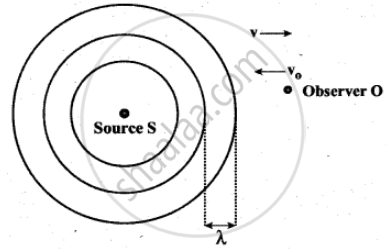
Observer moves towards Source
We can assume that the observer O moves towards the source S with velocity vo. The source S is at rest and the velocity of sound waves (with respect to the medium) produced by the source is v.
From the Figure, It is observed that both vo and v are in opposite direction. Then, their relative velocity is vr = v + vo. The wavelength of the sound wave is λ = `"v"/"f"`, which means the frequency observed by the observer O is f ‘ = `"v"_"r"/lambda`. Then
`"f"' = "v"_"r"/lambda = (("v" + "v"_0)/"v")"f"`
`= "f"(1 + "v"_0/"v")` ...(7)
(b) Observer recedes away from the Source:
If the observer O is moving away (receding away) from the source S, then velocity v0 and v move in the same direction. Hence, their relative velocity is vr = v – v0. Hence, the frequency observed by the observer O is
`"f"' = "v"_"r"/lambda = (("v" + "v"_0)/"v")"f"`
`= "f"(1 - "v"_0/"v")` ...(8)
APPEARS IN
RELATED QUESTIONS
What is meant by the Doppler effect?
A sound source and listener are both stationary and a strong wind is blowing. Is there a Doppler effect?
A bus is moving with a velocity of 5 m is towards a wall. The driver blows the horn of frequency 165 Hz. If the speed of sound in air is 335 m is, then after reflection of sound wave, the number of beats per second heard by the passengers in the bus will be ______.
A car sounding a horn of frequency 1000 Hz passes au observer. The ratio of frequencies of the horn noted by the observer before and after passing of the car is 11 : 9. If the speed of sound is 'V', the speed of the car is ______.
With what velocity an observer should move relative to a stationary source so that a sound of double the frequency of source is heard by an observer?
The frequency of a car horn encountered a change from 400 Hz to 500 Hz, when the car approaches a vertical wall. If the speed of sound is 330 m/s. Then the speed of car is ______ km/h.
When a sound source of frequency n is approaching a stationary observer with velocity u than the apparent change in frequency is Δn1 and when the same source is receding with velocity u from the stationary observer than the apparent change in frequency is Δn2. Then ______.
A racing car moving towards a cliff sounds its horn. The sound reflected from the cliff has a pitch one octave higher than the actual sound of the horn. If V is the velocity of sound, the velocity of the car is ______.
The frequency of echo will be ______ Hz if the train blowing a whistle of frequency 320 Hz is moving with a velocity of 36 km/h towards a hill from which an echo is heard by the train driver. The velocity of sound in air is 330 m/s.
The pitch of the whistle of an engine appears to drop by 20% of its original value when it passes a stationary observer. If the speed of sound in the air is 350 m/s, then the speed of the engine (in m/s) is ______.
