Advertisements
Advertisements
प्रश्न
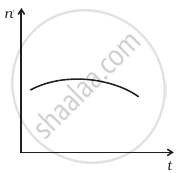
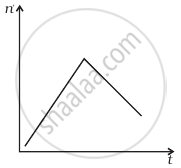
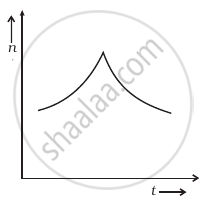
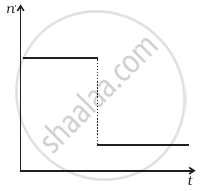
A train whistling at constant frequency is moving towards a station at a constant speed V. The train goes past a stationary observer on the station. The frequency n ′ of the sound as heard by the observer is plotted as a function of time t (figure). Identify the expected curve.
पर्याय
Advertisements
उत्तर
Explanation:
Let the original frequency of the source is n0.
Let the speed of sound wave n the medium be v.
As the observer is stationary

Apparent frequency `n_a = (v/(v - v_s)) n_o` ......[When the train is approaching]
= `(v/(v - v_s)) n_o`
= `n_a > n_o`
When the train is going away from the observer
Apparent frequency `n_a = (v/(v +v_s)) n_0`
= `n_a < n_o`
APPEARS IN
संबंधित प्रश्न
A narrow sound pulse (for example, a short pip by a whistle) is sent across a medium. (a) Does the pulse have a definite (i) frequency, (ii) wavelength, (iii) speed of propagation? (b) If the pulse rate is 1 after every 20 s, (that is the whistle is blown for a split of second after every 20 s), is the frequency of the note produced by the whistle equal to 1/20 or 0.05 Hz
In discussing Doppler effect, we use the word "apparent frequency". Does it mean that the frequency of the sound is still that of the source and it is some physiological phenomenon in the listener's ear that gives rise to Doppler effect? Think for the observer approaching the source and for the source approaching the observer.
The engine of a train sounds a whistle at frequency v. The frequency heard by a passenger is
State the expression for apparent frequency when listener is stationary and source is moving towards the listener.
Answer briefly.
State the expression for apparent frequency when the source is stationary and the listener is
- moving towards the source
- moving away from the source
Answer briefly.
State the expression for apparent frequency when source of sound and listener are
- moving towards each other
- moving away from each other
The sound emitted from the siren of an ambulance has a frequency of 1500 Hz. The speed of sound is 340 m/s. Calculate the difference in frequencies heard by a stationary observer if the ambulance initially travels towards and then away from the observer at a speed of 30 m/s.
Explain red shift and blue shift in Doppler Effect.
What is meant by the Doppler effect?
Discuss the following case:
Source in motion and Observer at rest
- Source moves towards observer
- Source moves away from the observer
How do animals sense impending danger of hurricane?
An observer moves towards a stationary source of sound with a velocity one-fifth of the velocity of sound. The percentage increase in the apparent frequency heard by the observer will be ______.
A sitar wire is replaced by another wire of same length and material but of three times the earlier radius. If the tension in the wire remains the same, by what factor will the frequency change?
A train standing at the outer signal of a railway station blows a whistle of frequency 400 Hz still air. The train begins to move with a speed of 10 ms–1 towards the platform. What is the frequency of the sound for an observer standing on the platform? (sound velocity in air = 330 ms–1)
A train moving at 25 m/s emits a whistle of frequency 200 Hz. If the speed of sound in air is 340 m/s, find the frequency observed by a stationary observer.
- if the observer is in front of the source.
- if the observer is behind the train.
The period of rotation of the sun at its equator is T and its radius is R. Then the Doppler wavelength shift expected for light with wavelength λ emitted from the edge of the sun's disc is: [c = speed of light]
When an engine passes near to a stationary observer then its apparent frequencies occurs in the ratio 5/3. If the velocity of engine is ______.
The observer is moving with velocity 'v0' towards the stationary source of sound and then after crossing moves away from the source with velocity 'v0'. Assume that the medium through which the sound waves travel is at rest. If v is the velocity of sound and n is the frequency emitted by the source, then the difference between apparent frequencies heard by the observer is ______.
The pitch of whistle of an engine appears to drop by 30% of the original value when it passes a stationary observer. If speed of sound in air is 350 m/s, then the speed of engine in m/s is ______.
