Advertisements
Advertisements
Question
A pulley system has three pulleys. A load of 120 N is overcome by applying an effort of 50N. Calculate the Mechanical Advantage and Efficiency of this system.
Advertisements
Solution
Load = 120 N; E = 50 N; n = 3
Mechanical advantage of pulley system is
M.A. = `L/E = 120/50` = 2.4
The efficiency of the system is
`eta = ("M.A.")/("V.R.") = (2.4)/n = 2.4/3 = 0.8 = 80%`
APPEARS IN
RELATED QUESTIONS
A boy uses a single fixed pulley to lift a load of 50 kgf to some height. Another boy uses a single movable pulley to lift the same load to the same height. Compare the effort applied by them. Give a reason to support your answer.
From the diagram given below. answer the question that follows:
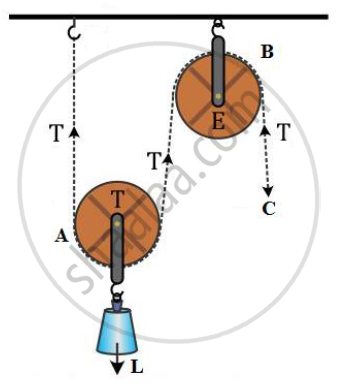
1) What kind of pulleys are A and B?
2) State the purpose of pulley B.
3) What effort has to be applied at C just raise the load L = 20 kgf?
(Neglect the weight of pulley A and friction)
The mechanical advantage of an actual pulley is less than one. Give a reason. What is the justification for using the pulley then?
State if the following statement is true or false. Correct the statement if it is false.
A single movable pulley is a pulley that has its axis of rotation fixed.
Differentiate between a single fixed pulley and a single movable pulley.
What is a block and tackle system of pulleys?
Give a reason for the following:
In a single fixed pulley, the velocity ratio is always more than the mechanical advantage.
Name a machine which is used to:
change the direction of force applied.
The alongside figure shows the combination of a movable pulley P1 with a fixed pulley P2 used for lifting up a load W.

(i) State the function of the fixed pulley P2.
(ii) If the free end of the string moves through a distance x, find the distance by which the load W is raised.
(iii) Calculate the force to be applied at C to just raise the load W = 20 kgf, neglecting the weight of the pulley P1 and friction.
State one advantage of single movable pulley.
