Advertisements
Advertisements
Question
A boy uses a single fixed pulley to lift a load of 50 kgf to some height. Another boy uses a single movable pulley to lift the same load to the same height. Compare the effort applied by them. Give a reason to support your answer.
Advertisements
Solution
The ratio of load to the effort is called the mechanical advantage.
Mechanical advantage (MA) = `"Load(l)"/"Effort(E)"`
The above equation indicates that 'MA' and 'Effort' are inversely proportional.
The mechanical advantage of the single fixed pulley is 1.
For, single movable pulley = 50 kgf
:. Effort (Esingle fixed pulley) = `"Load"/(MA_"single fixed pulley")`
= `50/1 = 50` kgf
Effort (Esingle fixed pulley) = `"Load"/(MA_"single movable pulley")`
= `50/2 = 25` kgf
Therefore, the boy using a single movable pulley requires lesser effort to lift an equal load of 50 kgf when compared with the effort required by the boy using a single fixed pulley.
APPEARS IN
RELATED QUESTIONS
The pulley system has drawn lifts a load of 150 N when an effort of 60 N is applied. Find its mechanical advantage.
Fill in the blank:
A pulley is used to change ........................
State two functions of a machine.
Solve the following numerical problem.
What effort will be required to lift a load of 500 N by a single movable pulley? [Hint: Mechanical advantage of a single movable pulley is two].
Name a machine to change the direction of force ?
What is the use of a fixed pulley?
Fig shown a block and tackles system of pulleys used to lift a load.
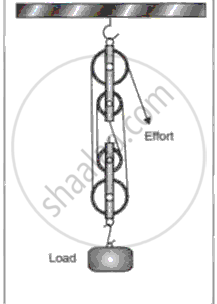
(i) How many strands of tackle are supporting the load?
(ii) Draw arrows to represent tension in each stand.
(iii) What is the mechanical advantage of the system?
(iv) When load is pulled up by a distance 1 m how far does the effort end move?
What is a block and tackle system of pulleys? What precautions would you observe while rounding the string so that the effort is applied in the downward direction?
Diagram given below shows an arrangement of four pulleys. A load L is attached to the movable lower block and effort E is applied at the free end of the string.
Copy the diagram; and

(i) Draw arrows to indicate tension in each part of the string; and
(ii) Calculate the mechanical advantage of the system.
A ‘block and tackle’ system used 3 pulleys in the lower block and 4 pulleys in the upper block. What is the ‘velocity ratio’ of this system? If the load is to be lifted by a person capable of applying a maximum effort of 1000 N, what is the maximum load than can be lifted under ideal conditions?
The actual maximum load that gets lifted turns out to be 6300 N. What are the values of the actual M.A. and efficiency of the set-up?
