Advertisements
Advertisements
Question
From the diagram given below. answer the question that follows:
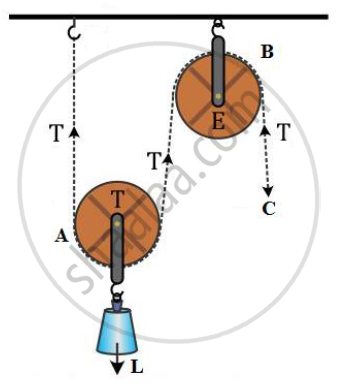
1) What kind of pulleys are A and B?
2) State the purpose of pulley B.
3) What effort has to be applied at C just raise the load L = 20 kgf?
(Neglect the weight of pulley A and friction)
Advertisements
Solution
1) The pulley A is a single movable pulley and B is a single fixed pulley.
2) Pulley B is a single fixed type pulley. Its purpose is to change the direction of the effort applied.
3) The effort at C is equal to the load. This is because B is a single fixed pulley and its mechanical advantage is 1. So, we have
M.A. = L/E = 1
∴ E = L = 20 kgf
APPEARS IN
RELATED QUESTIONS
Fill in the blank:
A pulley is used to change ........................
State if the following statement is true or false. Correct the statement if it is false.
A single movable pulley is a pulley that has its axis of rotation fixed.
What is a gear system ?
Explain the working of a gear system.
What is a single movable pulley? What is its mechanical advantage in the ideal case?
Give reason for the following:
The lower block of a block and tackle pulley system must be of negligible weight
Fig shown a block and tackles system of pulleys used to lift a load.
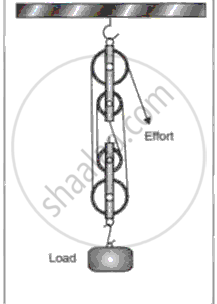
(i) How many strands of tackle are supporting the load?
(ii) Draw arrows to represent tension in each stand.
(iii) What is the mechanical advantage of the system?
(iv) When load is pulled up by a distance 1 m how far does the effort end move?
State one advantage of single movable pulley.
