Advertisements
Advertisements
प्रश्न
From the diagram given below. answer the question that follows:
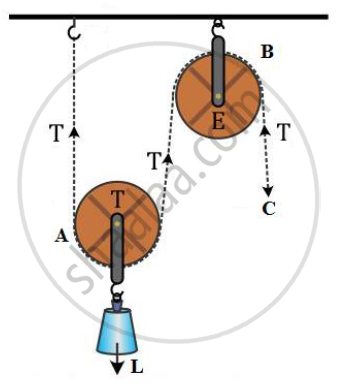
1) What kind of pulleys are A and B?
2) State the purpose of pulley B.
3) What effort has to be applied at C just raise the load L = 20 kgf?
(Neglect the weight of pulley A and friction)
Advertisements
उत्तर
1) The pulley A is a single movable pulley and B is a single fixed pulley.
2) Pulley B is a single fixed type pulley. Its purpose is to change the direction of the effort applied.
3) The effort at C is equal to the load. This is because B is a single fixed pulley and its mechanical advantage is 1. So, we have
M.A. = L/E = 1
∴ E = L = 20 kgf
APPEARS IN
संबंधित प्रश्न
Is the above pulley system an ideal machine or not?
What is the mechanical advantage of an ideal pulley?
The mechanical advantage of an actual pulley is less than one. Give a reason. What is the justification for using the pulley then?
Draw a neat labelled diagram showing a pulley being used to lift a load. How are load and effort related in an ideal situation?
In a gear system, the gear ration of the driving wheel A and driven wheel B is 10:1. To rotate the driven wheel B in the direction of driving wheel A, the driving wheel A is engaged with other wheel C. what should be the gear ratio of the wheels A and C?
What is a block and tackle system of pulleys?
What is a block and tackle system of pulleys?
A type of single pulley is very often used as a machine even though it does not give any gain in mechanical advantage. Name the type of pulley used.
State one advantage of single movable pulley.
A block and tackle system of pulleys has a velocity ratio of 4.
- Draw a labelled diagram of the system indicating clearly the direction of the load and effort.
- Calculate the potential energy of the load 100 kgf lifted by this pulley to a height 5 m. (g = 10 ms−2)
