Advertisements
Advertisements
Question
A project schedule has the following characteristics
| Activity | 1 - 2 | 1 - 3 | 2 - 4 | 3 - 4 | 3 - 5 | 4 - 9 | 5 - 6 | 5 - 7 | 6 - 8 | 7 - 8 | 8 - 10 | 9 - 10 |
| Time | 4 | 1 | 1 | 1 | 6 | 5 | 4 | 8 | 1 | 2 | 5 | 7 |
Construct the network and calculate the earliest start time, earliest finish time, latest start time and latest finish time of each activity and determine the Critical path of the project and duration to complete the project.
Advertisements
Solution

E1 = 0
E2 = 0 + 4 = 4
E3 = 0 + 1 = 1
E4 = 4 + 1 = 5
E5 = 1 + 6 = 7
E6 = 7 + 4 = 11
E7 = 8 + 7 = 15
E8 = 15 + 2 = 7
E9 = 5 + 5 = 10
E10 = 17 + 5 = 22
L7 = 31
L10 = 22
L9 = 22 – 7 = 15
L8 = 22 – 5 = 17
L7 = 17 – 2 = 15
L6 = 17 – 1 = 16
L5 = (16 – 4) or (15 – 8)
whichever is minimum = 7
L4 = 15 – 5 = 10
L3 = (10 – 1) or (7 – 6)
whichever is minimum = 1
L2 = 10 – 1 = 9
L1 = 0
| Activity | Duration tij |
EST | EFT = EST + tij | LST = LFT – tij | LFT |
| 1 - 2 | 4 | 0 | 4 | 9 – 4 = 5 | 9 |
| 1 - 3 | 1 | 0 | 1 | 1 – 1 = 0 | 1 |
| 2 - 4 | 1 | 4 | 5 | 10 – 1 = 9 | 10 |
| 3 - 4 | 1 | 1 | 2 | 10 – 1 = 9 | 10 |
| 3 - 5 | 6 | 1 | 7 | 7 – 6 =1 | 7 |
| 4 - 9 | 5 | 5 | 10 | 15 – 5 =10 | 15 |
| 5 - 6 | 4 | 7 | 11 | 16 4 = 12 | 16 |
| 5 - 7 | 8 | 7 | 15 | 15 – 8 = 7 | 15 |
| 6 - 8 | 1 | 11 | 12 | 17 – 1 = 16 | 17 |
| 7 - 8 | 2 | 15 | 17 | 17 – 2 = 15 | 17 |
| 8 - 10 | 5 | 17 | 22 | 22 – 5 = 17 | 22 |
| 9 - 10 | 7 | 10 | 17 | 22 – 7 = 15 | 22 |
Since EFT and LFT is same on 1 - 3, 3 - 5, 5 - 7 and 7 - 8 and 8 - 10 the critical path is 1 - 3 - 5 - 7 - 8 - 10 and the duration is 22 time units.
APPEARS IN
RELATED QUESTIONS
Draw the network for the project whose activities with their relationships are given below:
Activities A, D, E can start simultaneously; B, C > A; G, F > D, C; H > E, F.
Draw the network and calculate the earliest start time, earliest finish time, latest start time and latest finish time of each activity and determine the Critical path of the project and duration to complete the project.
| Jobs | 1 - 2 | 1 - 3 | 2 - 4 | 3 - 4 | 3 - 5 | 4 - 5 | 4 - 6 | 5 - 6 |
| Duration | 6 | 5 | 10 | 3 | 4 | 6 | 2 | 9 |
The critical path of the following network is
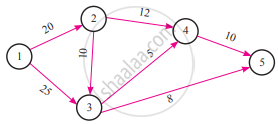
One of the conditions for the activity (i, j) to lie on the critical path is
Which of the following is not correct?
The objective of network analysis is to
Network problems have the advantage in terms of project
Draw a network diagram for the following activities.
| Activity code | A | B | C | D | E | F | G | H | I | J | K |
| Predecessor activity | - | A | A | A | B | C | C | C, D | E, F | G, H | I, J |
Draw the network diagram for the following activities.
| Activity code | A | B | C | D | E | F | G |
| Predecessor activity | - | - | A | A | B | C | D, E |
The following table gives the characteristics of the project
| Activity | 1 - 2 | 1 - 3 | 2 - 3 | 3 - 4 | 3 - 5 | 4 - 6 | 5 - 6 | 6 - 7 |
| Duration (in days) |
5 | 10 | 3 | 4 | 6 | 6 | 5 | 5 |
Draw the network for the project, calculate the earliest start time, earliest finish time, latest start time and latest finish time of each activity and find the critical path. Compute the project duration.
