Advertisements
Advertisements
Question
A hydrocarbon (A) with molecular formula C5H10 on ozonolysis gives two products (B) and (C). Both (B) and (C) give a yellow precipitate when heated with iodine in presence of NaOH while only (B) give a silver mirror on reaction with Tollen’s reagent.
- Identify (A), (B) and (C).
- Write the reaction of B with Tollen’s reagent.
- Write the equation for iodoform test for C.
- Write down the equation for aldol condensation reaction of B and C.
Advertisements
Solution
a. A is an alkene.
B is an aldehyde with –CH3 group.
C is a methyl ketone.
b. \[\ce{CH3CHO + [Ag(NH3)2]^{+} + OH^{-} -> CH3COO^{-} + Ag + NH3 + H2O}\]
c. \[\ce{CH3COCH3 + NaOH + I2 -> CHl3 + CH3COONa}\]
d. A: CH(CH3) = C(CH3)2, B: CH3CHO, C: O = C(CH3)2
\[\begin{array}{cc}
\ce{CH3COCH3 + CH3CHO}\phantom{............................................................................}\\
\ce{↓ Ba(OH)2}\phantom{.....................................................................}\\
\phantom{}\ce{(CH3)2C(OH)CH2COCH3 + CH3CH(OH)CH2CHO + (CH3)2C(OH)CH2CHO + CH3CH(OH)CH2COCH3}\\
\ce{↓ Heat}\phantom{.........................................................................}\\
\ce{(CH3)2C = CHCOCH3 + CH3CH = CHCHO + (CH3)2C = CHCHO + CH3CH = CHCOCH3}\phantom{............}
\end{array}\]
APPEARS IN
RELATED QUESTIONS
Predict the products of the following reactions :

Propanal and Propanone
Give a simple chemical test to distinguish between the following pair of compounds:
Acetophenone and Benzophenone
Give a simple chemical test to distinguish between the following pair of compounds:
Benzoic acid and Ethyl benzoate
Oxidation of ketones involves carbon-carbon bond cleavage. Name the products formed on oxidation of 2, 5-dimethylhexan-3-one.
Acetaldehyde cannot show?
The major products formed in the following reaction sequence A and B are:

An organic compound 'A' with the molecular formula C4H8O2 undergoes acid hydrolysis to form two compounds 'B' and 'C'. Oxidation of 'C' with acidified potassium permanganate also produces 'B'. Sodium salt of 'B' on heating with soda lime gives methane.
- Identify 'A', 'B' and 'C'.
- Out of 'B' and 'C', which will have higher boiling point? Give reason.
Match List-I with List-II:
| List-I (Reaction) |
List-II (Reagents/Condition) |
||
| A. | 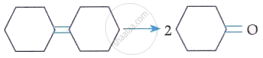 |
I. | 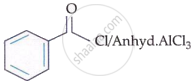 |
| B. | 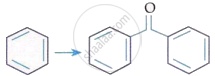 |
II. | CrO3 |
| C. | 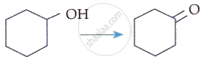 |
III. | KMnO4/KOH, Δ |
| D. |  |
IV. | (i) O3 (ii) Zn-H2O |
Choose the correct answer from the options given below:
