Advertisements
Advertisements
Question
An organic compound contains 69.77% carbon, 11.63% hydrogen and rest oxygen. The molecular mass of the compound is 86. It does not reduce Tollens’ reagent but forms an addition compound with sodium hydrogensulphite and give positive iodoform test. On vigorous oxidation it gives ethanoic and propanoic acid. Write the possible structure of the compound.
Advertisements
Solution
(a) Finding the molecular formula of a compound:
Percentage of carbon = 69.77%
Percentage of hydrogen = 11.63%
∴ Percentage of oxygen = 100 – (69.77 + 11.63)
= 18.6%
C : H : O = `69.77/12 : 11.63/1 : 18.6/16`
= 5.81 : 11.63 : 1.16
∴ Simple ratio = 5 : 10 : 1
Empirical formula of the given compound = C5H10O
Empirical formula mass = 5 × 12 + 10 × 1 + 1 × 16 = 86
Molecular mass = 86 ...(Given)
Molecular formula = C5H10O × `86/86` = C5H10O
Thus, the molecular formula of the given compound is C5H10O.
(b) Determining the structure of a compound:
- Since the given compound forms a divalent compound with sodium hydrogensulphite, it must be an aldehyde or a ketone.
- Since the compound does not reduce Tollen's reagent, it cannot be an aldehyde. Hence, it must be a ketone.
- Since the compound gives an iodoform test, the given compound is methyl ketone.
- Since the given compound gives a mixture of ethanoic acid and propanoic acid on vigorous oxidation, methyl ketone is pentane-2-one. Its structure is as follows:
\[\begin{array}{cc}
\ce{O}\phantom{........}\\
||\phantom{........}\\
\ce{\underset{Pentan-2-one}{CH3 - C - CH2CH2CH3}}
\end{array}\]
(c) Details of the reactions involved:
\[\begin{array}{cc}
\phantom{.................}\ce{O}\phantom{...........................}\ce{OH}\phantom{.....}\ce{S\overset{-}{O}_3N\overset{+}{a}}\\
\phantom{..........}||\phantom{...............................}\backslash\phantom{...}/\\
\ce{CH3 - \underset{Pentan-2-one}{C - CH2}CH2CH3 + NaHSO3 -> C}\\
\phantom{..........................................}/\phantom{...}\backslash\\
\phantom{..................................}\ce{\underset{Sodium Hydrogen Sulphite Additive Products}{CH3CH2H2C \phantom{.....}CH3}}
\end{array}\]
\[\begin{array}{cc}
\ce{O}\phantom{....................................................................................}\\
||\phantom{....................................................................................}\\
\ce{CH3 - \underset{Pentan-2-one}{C - CH2}CH2CH3 + 3I2 + 4NaOH ->[Iodoform][reaction]\underset{(Yellow ppt)}{\underset{Iodoform}{CH3\downarrow}} + CH3CH2CH2COONa + 3NaI + 3H2O}
\end{array}\]
\[\begin{array}{cc}
\ce{O}\phantom{...............................................}\\
||\phantom{...............................................}\\
\ce{CH3 - \underset{Pentan-2-one}{C - CH2}CH2CH3->[K2Cr2O7][H2SO4] \underset{Ethanoic acid}{CH3COOH} + \underset{Propanoic acid}{CH3CH2COOH}}
\end{array}\]
APPEARS IN
RELATED QUESTIONS
Give a simple chemical test to distinguish between the following pair of compounds:
Ethanal and Propanal
Distinguish between: CH3COOH and HCOOH
Give a simple chemical test to distinguish between the following pair of compounds :
CH3CH2CHO and CH3CH2COCH3
Propanal and Propanone
How will you convert ethanal into the following compound?
But-2-enoic acid
Which of the following compounds will give butanone on oxidation with alkaline \[\ce{KMnO4}\] solution?
Which sugar does not reduce Fehling's solution?
Solvent used for dewaxing of petroleum products are
Acetaldehyde cannot show?
Fehilng's test is positive for
Ammonical silver nitrate solution is called

Which among the above compound/s does/do not form Silver mirror when treated with Tollen's reagent?
The correct set of products obtained in the following reactions:
- \[\ce{RCN ->[reduction]}\]
- \[\ce{RCN ->[(i) CH3MgBr][(ii) H2O]}\]
- \[\ce{RNC ->[hydrolysis]}\]
- \[\ce{RNH2 ->[HNO2]}\]
Choose the reaction which is not possible:
An organic compound 'A' with the molecular formula C4H8O2 undergoes acid hydrolysis to form two compounds 'B' and 'C'. Oxidation of 'C' with acidified potassium permanganate also produces 'B'. Sodium salt of 'B' on heating with soda lime gives methane.
- Identify 'A', 'B' and 'C'.
- Out of 'B' and 'C', which will have higher boiling point? Give reason.
Benzaldehyde is obtained from Rosenmund’s reduction of:
Match List-I with List-II:
| List-I (Reaction) |
List-II (Reagents/Condition) |
||
| A. | 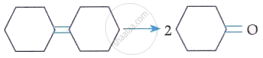 |
I. | 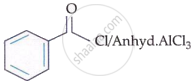 |
| B. | 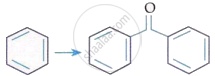 |
II. | CrO3 |
| C. | 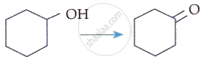 |
III. | KMnO4/KOH, Δ |
| D. |  |
IV. | (i) O3 (ii) Zn-H2O |
Choose the correct answer from the options given below:
Fehling’s solution ‘A’ is ______.
