Advertisements
Advertisements
Question
A glass prism is able to produce the spectrum when white light passes through it, but a glass slab doesn’t produce any spectrum. Explain why it is so.
Advertisements
Solution
The two faces of a glass prism are at an angle (angle of prism) with each other. Therefore, the angle of incidence and the angle of emergence of a light ray become different in the case of a prism. Therefore, when white light gets dispersed after entering a prism, its component colours spread more after refracting through the opposite face of the prism.
In the case of a glass slab, the two opposite faces of the slab are parallel to each other. Therefore, the angle of incidence and the angle of emergence of a light ray remain the same for a glass slab. Therefore, the dispersed light rays combine to form white light after refracting through the second face of the glass slab.
APPEARS IN
RELATED QUESTIONS
Define the term dispersion of white light.
What acts as tiny prisms in the formation of a rainbow?
The property of splitting of white light into its seven constituent colours is known as
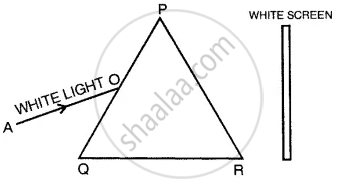
In figure AO is the ray of white light falling on a prism PQR. Complete the diagram till the light emerges out from the prism and falls on the screen.
In which of the following four diagrams is the correct path of a ray of light passing through a glass prism shown ?
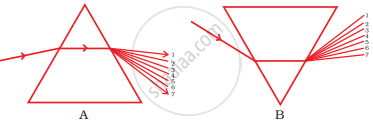
When we place a glass prism in the path of a narrow beam of white light a spectrum is obtained. What happens when a second identical prism is placed in an inverted position with respect to the first prism? Draw a labelled ray diagram to illustrate it.
A wave has wavelength 50Å of State the speed in vacuum.
The phenomenon of splitting of light into its component colours is ___________ .
State the correct sequence (1-7) of colours in the spectrum formed by the prisms A and B, shown in the following figure.
Curved mirrors have surfaces that are spherical, cylindrical, parabolic, and ellipsoid.
