Advertisements
Advertisements
Question
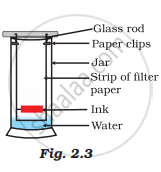
A child wanted to separate the mixture of dyes constituting a sample of ink. He marked a line by the ink on the filter paper and placed the filter paper in a glass containing water as shown in Fig.2.3. The filter paper was removed when the water moved near the top of the filter paper.
(i) What would you expect to see, if the ink contains three different coloured components?
(ii) Name the technique used by the child.
(iii) Suggest one more application of this technique.
Advertisements
Solution
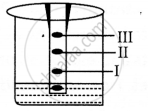
(i) The components of the ink will travel with water and we would see three bands on the filter paper at various lengths.
(ii) The technique is called chromatography.
(iii) Separation of pigments present in chlorophyll.
APPEARS IN
RELATED QUESTIONS
Calculate the amount of carbon dioxide that could be produced when 1 mole of carbon is burnt in air.
Explain the term mole fraction.
Solve the following problem:
Write the following number in ordinary decimal form:
0.011 × 10⁻³
A 1.000 mL sample of acetone, a common solvent used as a paint remover, was placed in a small bottle whose mass was known to be 38.0015 g.
The following values were obtained when the acetone-filled bottle was weighed: 38.7798 g, 38.7795 g and 38.7801 g. How would you characterise the precision and accuracy of these measurements if the actual mass of the acetone was 0.7791 g?
Name the process associated with the following
A drop of ink placed on the surface of water contained in a glass spreads throughout the water.
Give an example of each mixture having the following characteristics. Suggest a suitable method to separate the components of this mixture
Two immiscible liquids.
If 500 mL of a 5 M solution is diluted to 1500 mL, what will be the molarity of the solution obtained?
If the concentration of glucose \[\ce{(C6H12O6)}\] in blood is 0.9 g L–1, what will be the molarity of glucose in blood?
Match the following physical quantities with units
| Physical quantity | Unit |
| (i) Molarity | (a) g mL–1 |
| (ii) Mole fraction | (b) mol |
| (iii) Mole | (c) Pascal |
| (iv) Molality | (d) Unitless |
| (v) Pressure | (e) mol L–1 |
| (vi) Luminous intensity | (f) Candela |
| (vii) Density | (g) mol kg–1 |
| (viii) Mass | (h) Nm–1 |
| (i) kg |
Find the molality of solution if boiling point increases by 1.75 K and molal elevation constant of solvent is 5K kg mol-1.
