Advertisements
Advertisements
प्रश्न
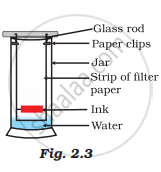
A child wanted to separate the mixture of dyes constituting a sample of ink. He marked a line by the ink on the filter paper and placed the filter paper in a glass containing water as shown in Fig.2.3. The filter paper was removed when the water moved near the top of the filter paper.
(i) What would you expect to see, if the ink contains three different coloured components?
(ii) Name the technique used by the child.
(iii) Suggest one more application of this technique.
Advertisements
उत्तर
(i) The components of the ink will travel with water and we would see three bands on the filter paper at various lengths.
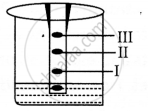
(ii) The technique is called chromatography.
(iii) Separation of pigments present in chlorophyll.
APPEARS IN
संबंधित प्रश्न
Calculate the molarity of a solution of ethanol in water in which the mole fraction of ethanol is 0.040 (assume the density of water to be one).
Solve the following problem:
Write the following number in ordinary decimal form:
5.16 × 10⁴
Perform the following calculation. Round off your answer to three digits.
(8.39 107) (4.53 109)
Solve the following problem:
What weight of calcium oxide will be formed on heating 19.3 g of calcium carbonate?
(At. wt.: Ca = 40; C = 12; O = 16)
What are the favourable qualities given to gold when it is alloyed with copper or silver for the purpose of making ornaments?
Which of the following terms are unitless?
(i) Molality
(ii) Molarity
(iii) Mole fraction
(iv) Mass percent
What is the difference between molality and molarity?
Match the following physical quantities with units
| Physical quantity | Unit |
| (i) Molarity | (a) g mL–1 |
| (ii) Mole fraction | (b) mol |
| (iii) Mole | (c) Pascal |
| (iv) Molality | (d) Unitless |
| (v) Pressure | (e) mol L–1 |
| (vi) Luminous intensity | (f) Candela |
| (vii) Density | (g) mol kg–1 |
| (viii) Mass | (h) Nm–1 |
| (i) kg |
250 g solution of D-glucose in water contains 10.8% of carbon by weight. The molality of the solution is nearest to ______.
(Given: Atomic weights are H, 1u; C, 12u; O, 16u)
Molarity of liquid HCl will be if the density of the solution is 1.17 g/cc.
